
AMD vs NVIDIA Graphics Card Brand Comparison
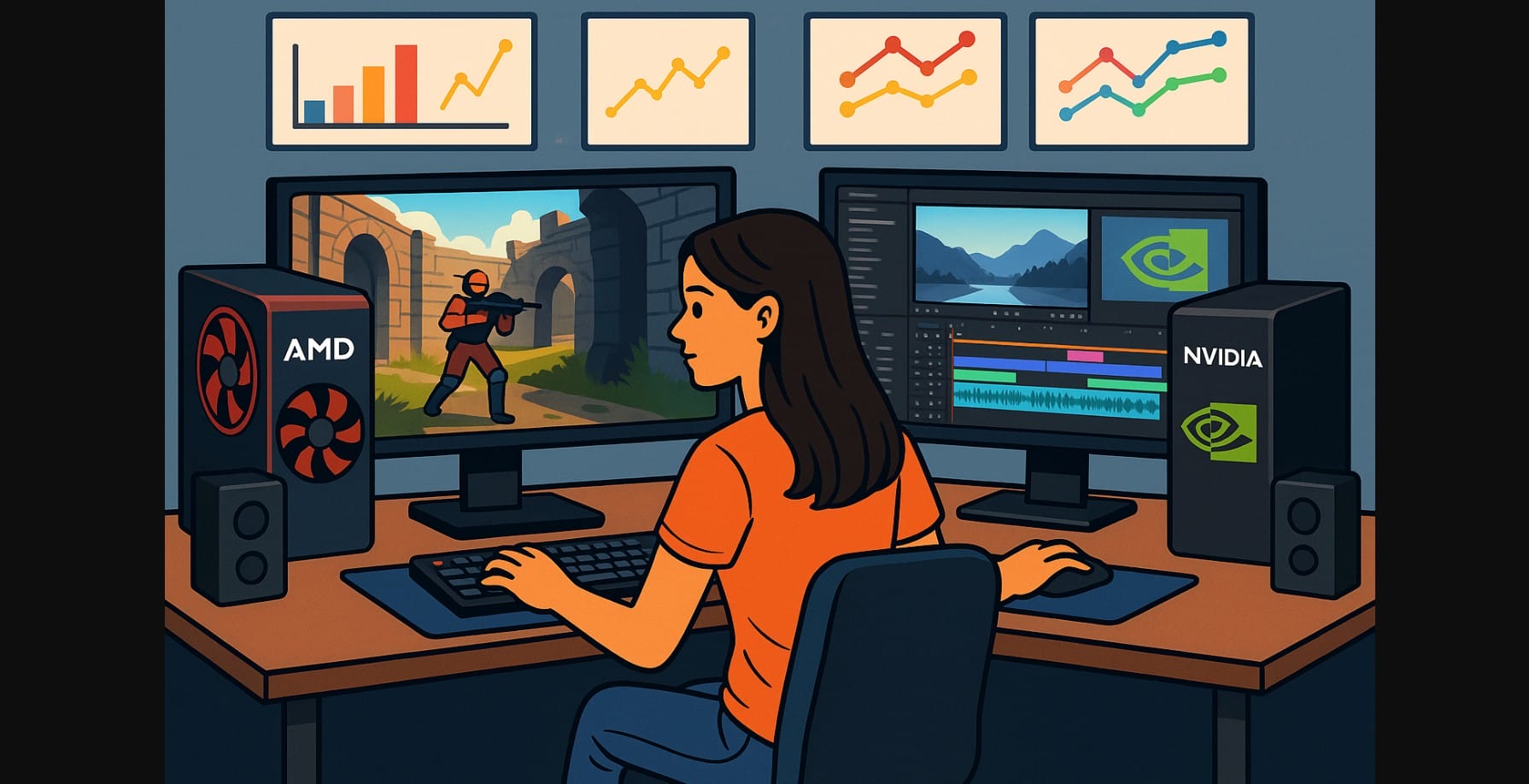
In India, buying a GPU isn’t just about raw performance, it’s about value, availability, compatibility, and how it performs in real-world use, like gaming at 1080p or editing videos for YouTube. While NVIDIA clearly dominates the Indian market in reach and variety, AMD has made meaningful progress with its RDNA 4-based RX 9000 series.
This isn’t a benchmark race, this is a comparison of how well each brand fits – what users actually do: game at 1440p, stream over limited broadband, edit 4K videos, or run local AI tasks.
1. AMD vs Nvidia – Gaming Performance Comparison
Rasterized Gaming Performance (No Ray Tracing)
- At 1080p and 1440p, AMD’s RX 7800 XT and RX 9070 XT are excellent value performers, often beating RTX 4070 Ti in raw FPS per rupee.
- If your priority is raw speed in competitive titles like Valorant, CS2, or Apex Legends, AMD delivers at lower cost.
Ray Tracing Gaming Still Favors NVIDIA
- AMD has improved with RDNA 4, but still lags in full RT-heavy games like Cyberpunk 2077 or Portal RTX.
- RTX 4070 and above handle Ray Tracing with better frame stability, DLSS support, and fewer dips.
Game Upscaling Tech, DLSS 4 vs FSR 4
- NVIDIA’s DLSS 4 (with frame generation) is mature, clean, and smooth.
- AMD’s FSR 4 is AI-powered now, but doesn’t match DLSS quality in edge clarity or motion stability, though it’s vendor-agnostic and works more broadly.
2. Editing & Content Creation, Where the Ecosystem Matters
Tool Compatibility Still Favors NVIDIA
- Adobe Premiere Pro, DaVinci Resolve, and Blender all run more smoothly on NVIDIA thanks to CUDA support and better plugin integration.
- AMD’s RX 9000 cards can still handle 4K timelines well, but rendering/export times are often 10-25% longer, especially on complex projects.
Streaming & Encoding
- NVIDIA’s NVENC encoder (AV1 capable) gives better quality at lower bitrates, perfect for Indian streamers with upload limits.
- OBS and other tools natively support NVENC presets.
- AMD’s encoder is improving but still lacks advanced tuning options.
3. AI & Local Model Workloads, CUDA Still Rules
- NVIDIA GPUs dominate AI workflows thanks to CUDA and Tensor cores.
- If you’re running Stable Diffusion, LLaMA models, AI filters, or Whisper locally, RTX cards offer better support and speed.
- AMD GPUs support ROCm now, but many AI tools still require hacks or don’t run optimally.
4. Graphics Card Driver Stability, Software, and Updates
NVIDIA: Broad, Consistent Support
- Frequent game-ready drivers, broad compatibility with games and creator tools.
- Extensive AIB partner support (Zotac, MSI, ASUS, etc.) means more choices for Indian buyers.
AMD: Improving, But Still Inconsistent
- Adrenalin Software is cleaner now, but:
- Occasional delayed driver updates
- Some bugs still persist in less optimized titles
- Fewer board partners = fewer choices
5. Graphics Card Availability in India – One-Sided Reality
- NVIDIA cards are widely available, from ₹15,000 to ₹3,00,000 (RTX 5090).
- AMD GPUs are mostly limited to ₹20,000-₹1,00,000 tier, with sporadic stock and fewer custom models.
- Budget gamers, casual users, and laptop buyers rarely see AMD options in showrooms or e-commerce bundles.
6. AMD vs Nvidia GPU Brand- Price-to-Performance Summary
| Task | NVIDIA Advantage | AMD Advantage |
|---|---|---|
| 1080p/1440p Gaming | DLSS 4, stable frame pacing | Lower price, better value per FPS |
| 4K Gaming | Better DLSS scaling, smoother RT | Budget 4K with RX 7900 XTX |
| Content Creation | NVENC, CUDA, better plugin support | Capable editing for less money |
| Streaming | Superior AV1 encoding | Usable, but fewer presets/tweaks |
| AI Workloads | CUDA + Tensor = faster + easier | ROCm works for basic use only |
| Driver/Software Ecosystem | Stable, well-supported | Still catching up |
| Availability in India | Easy to find, all price ranges | Mid-high tier only, harder to source |
7. Which Graphics Card Brand Is Better for You in India?
- If you want everything to just work, games, AI, editing, streaming, go NVIDIA.
- If you’re a gamer focused purely on 1080p/1440p FPS value, don’t care about ray tracing or AI, and want to save ₹10,000+, AMD RX 7800 XT or 9070 XT makes total sense.
- For pc buyers in India, NVIDIA still leads in range, resale, and ecosystem, while AMD fights back with raw performance-per-rupee in limited segments.
Buy based on Price and Performance and how you use your PC, not just the brand.

