
Intel i5-13400F vs i5-14400F vs AMD Ryzen 7 5700: A Practical CPU Comparison
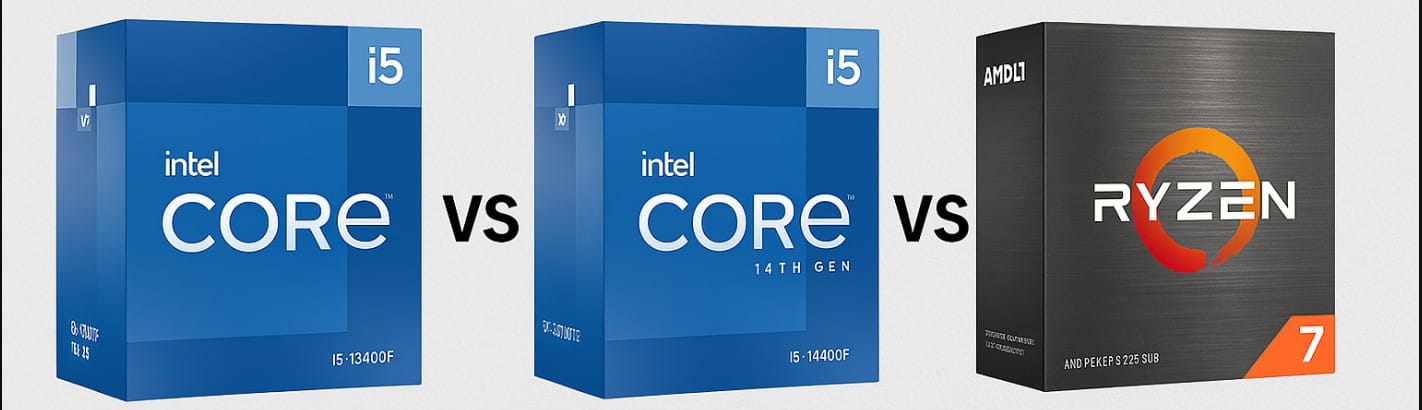
If you’re building a PC in India this year, you’ve probably noticed three processors clustered around the same price, Intel Core i5-13400F, i5-14400F, and AMD Ryzen 7 5700. At first glance, all seem like solid options for mid-range builds. But once you compare performance, compatibility, and platform life, they’re designed for very different priorities.
Let’s break down how each one performs, what you’re getting for your money, and which CPU suits your build best.
1. Three Processors, One Price Tag, Very Different Builds
All three CPUs are priced under ₹14,000 across Indian retailers. At that price, they compete directly in gaming, multitasking, and creator-focused builds. But the architecture, platform support, and upgrade potential vary significantly.
- Intel i5-13400F offers a hybrid architecture with 6 performance and 4 efficiency cores
- Intel i5-14400F builds on the same structure with a slight frequency bump
- AMD Ryzen 7 5700 provides 8 full cores without mixing in smaller efficiency cores, on the older AM4 platform
Each is viable, but the ideal pick depends on your usage and whether you’re building from scratch or reusing parts.
2. Intel i5-13400F vs i5-14400F vs AMD Ryzen 7 5700 Tech Comparison
| CPU | Price | Cores / Threads | Base / Boost Clock | L3 Cache | Platform | PCIe Support | TDP |
|---|---|---|---|---|---|---|---|
| i5-13400F | ₹12,999 | 10 (6P + 4E) / 16 | 2.5 / 4.6 GHz | 20 MB | LGA1700 (DDR4/DDR5) | PCIe 5.0 x16 | 65W |
| i5-14400F | ₹13,000 | 10 (6P + 4E) / 16 | 2.5 / 4.7 GHz | 20 MB | LGA1700 (DDR4/DDR5) | PCIe 5.0 x16 | 65W |
| Ryzen 7 5700 | ₹13,200 | 8 / 16 | 3.7 / 4.6 GHz | 16 MB | AM4 (DDR4 only) | PCIe 3.0 x16 | 65W |
3. What You Can Expect in Games
In gaming, Intel’s i5-13400F and 14400F have the edge, especially in titles that scale with higher boost clocks or single-core speeds. Paired with mainstream GPUs like RX 7600 or RTX 4060, the differences look like this:
- i5-14400F leads by 5-7% in FPS over Ryzen 7 5700 at 1080p
- i5-13400F matches or slightly trails the 14400F, still ahead of Ryzen in most games
- Ryzen 7 5700 does better in CPU-heavy games or multitasking while gaming
If you’re pairing with a 144Hz monitor, the Intel chips extract more frame stability, but all three are playable with a mid-range GPU.
4. Multitasking and Workflow Performance
This is where Ryzen 7 5700 starts to pull ahead. With 8 full cores and 16 threads, it handles multitasking and creator tools better than either i5.
- Tasks like video editing, Blender rendering, and background streaming perform more consistently
- Intel chips rely on 4 efficiency cores, which help with small tasks but can slow under continuous heavy load
- Ryzen delivers more consistent performance across long sessions without thermal throttling
If you’re doing regular content creation or handling multiple apps at once, the 5700 holds a practical advantage.
5. Hardware Compatibility and Upgrades You Should Know
Intel LGA1700 (13400F / 14400F)
- Supports DDR4 or DDR5, depending on the motherboard
- Offers PCIe 5.0 for GPUs and PCIe 4.0 for SSDs
- Compatible with B660 and B760 boards
- Limited upgrade path — newer LGA1851 socket is now active for future Intel CPUs
AMD AM4 (Ryzen 7 5700)
- Supports DDR4 only
- Limited to PCIe 3.0 for both GPU and SSD
- Compatible with most B450 and B550 boards
- AM4 has no new CPUs coming, but support and availability remain strong
For builders who already own a B450 or B550 board, dropping in the 5700 is straightforward. Just confirm BIOS support before installing.
6. Cooler and Power Differences That Affect Build Quality
- All three CPUs include a stock cooler
- Ryzen 7 5700’s Wraith Spire performs better in sustained workloads
- Intel’s Laminar RM1 cooler is smaller and tends to run hotter and louder under load
- The 5700 stays cooler and quieter in basic cabinets with limited airflow
If you’re not planning to buy an aftermarket cooler, Ryzen offers more thermal stability.
7. PCIe and NVMe Support: What Changes Long-Term Use
- Intel supports Gen 5 GPU lanes and Gen 4 NVMe SSDs, which improves transfer speeds for creators using large file workflows
- Ryzen is limited to Gen 3 still fast enough for most gamers, but not ideal for future-proof builds or high-performance SSDs
- If you plan on keeping your system for 4+ years or using it for file-heavy applications, Intel gives you more bandwidth headroom
8. i5-13400F vs 14400F vs Ryzen 7 5700 – Pricing in India
| CPU | Street Price (₹) | Typical Bundle Price (with motherboard) |
|---|---|---|
| i5-13400F | ₹12,999 | ₹20,000 – ₹22,500 |
| i5-14400F | ₹13,000 | ₹20,500 – ₹23,000 |
| Ryzen 7 5700 | ₹13,200 | ₹20,000 – ₹25,000 |
These prices are based on listings from Amazon, and Flipkart. Motherboard bundles usually include B660/B760 (Intel) or B550/B450 (AMD).
9. Pick Processor Based on What You’re Building
| Build Scenario | Recommended CPU |
|---|---|
| Gaming with RTX 4060 or RX 7600 | i5-14400F/i5-13400F |
| Video editing, Blender, or multitasking | Ryzen 7 5700 |
| Quiet build without buying a new cooler | Ryzen 7 5700 |
| New DDR5 + PCIe 4/5 platform setup | i5-14400F |
| Upgrading an old AM4 build | Ryzen 7 5700 |
Summary – Which One Delivers More Value in India
If you’re focused on high refresh gaming and future platform upgrades, Intel’s i5-14400F offers a balanced path forward. The i5-13400F is nearly identical in gaming and saves a bit on the CPU side. But if your needs extend beyond games, into editing, multitasking, or daily workloads with heavier apps, the Ryzen 7 5700 gives you more full cores for the money and runs cooler with less power draw.

