
String vs Microinverters: What’s Better for Your Rooftop Solar System?
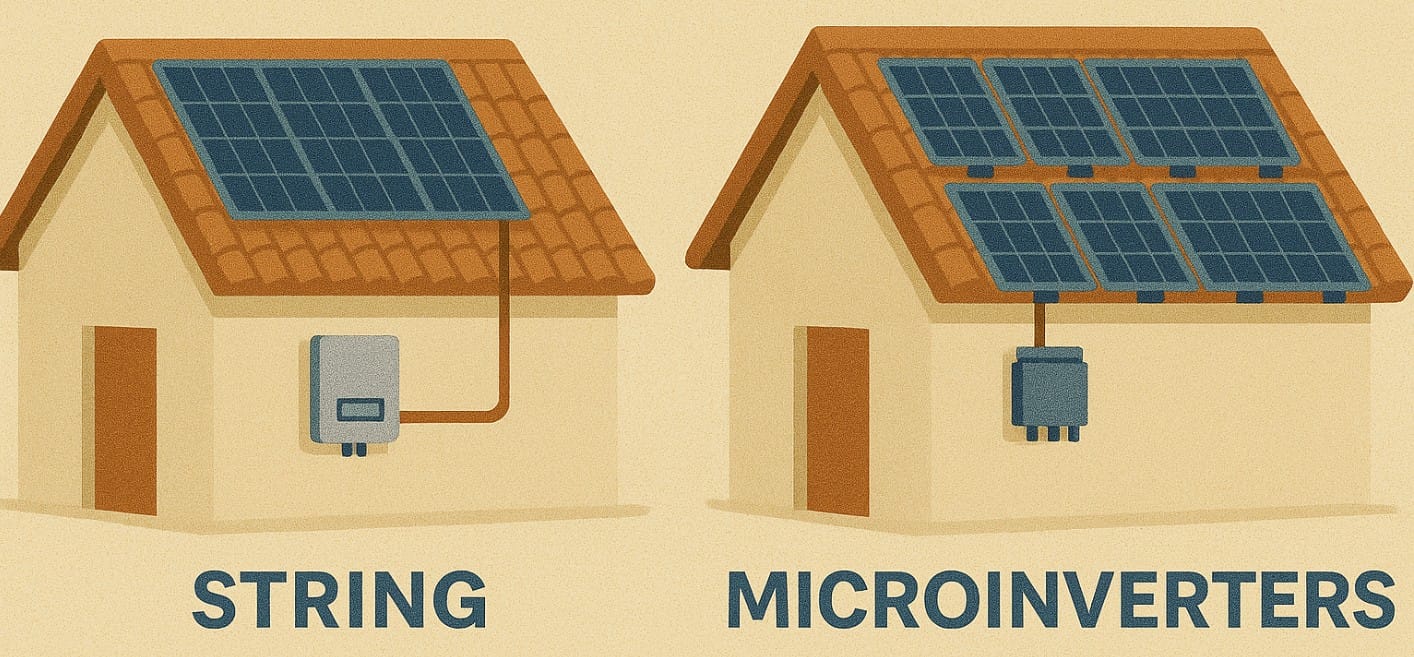
When installing rooftop solar in India, most homeowners focus on panels and price. But the inverter the hidden brain of your system plays a critical role in how much power you actually get.
The two main types available in India are:
- String inverters – widely used, cost-effective
- Microinverters – newer, more precise, but more expensive
Choosing the right one can directly affect your system efficiency, safety, and long-term savings.
Let’s break down how they work and which one fits your home better.
1. What Is a String Inverter and Why It’s So Common in India
A string inverter connects a group (or “string”) of solar panels to one central inverter. It converts the DC power from all those panels into AC power for your home.
It’s the most widely used type in Indian homes because it’s:
- Affordable
- Easy to install
- Supported by nearly every solar vendor
When It Works Well
- You have a flat, shade-free terrace
- All your panels face one direction
- You’re installing 2-5 kW systems
Limitations
- One panel affects all: if one gets shaded or dirty, the output of the entire string drops
- Basic monitoring: you get only total system output, not panel-wise performance
2. What Are Microinverters and How They Work Differently
Microinverters are small inverters placed directly under each panel. Each panel operates independently, converting DC to AC right on the roof.
This makes the system smarter, safer, and more efficient especially in complex rooftops or partially shaded homes.
Where They Shine
- Panels installed on multiple orientations (e.g. east and west)
- Homes with water tanks, trees, or neighbour’s walls causing shade
- People who want panel-level monitoring and maximum control
What to Keep in Mind
- Cost is 30-50% higher than string inverters
- Fewer installers offer microinverter systems outside metro cities
- Maintenance is harder if a single microinverter needs servicing
3. String vs. Microinverter Comparison – Pick the Right Inverter for Your Roof
| Feature | String Inverter | Microinverter |
|---|---|---|
| Location | Central (wall-mounted) | On each solar panel |
| Panel Independence | No – all panels work as a group | Yes – each panel works individually |
| Shade Handling | Poor – one shaded panel affects all | Excellent – others continue unaffected |
| Monitoring Detail | Basic – system-wide | Advanced – panel-level data |
| Cost | Lower (~₹40K-₹60K less overall) | Higher (~₹20K+ per kW extra) |
| Maintenance | Easier (1 device) | Complex (many devices on roof) |
| Suitability in India | Best for clear rooftops, basic layouts | Best for shaded or split rooftops, villas |
4. How Much More Will Microinverters Cost?
| System Size | With String Inverter (₹) | With Microinverter (₹) |
|---|---|---|
| 2 kW | ₹90,000-₹1.1 lakh | ₹1.3-₹1.6 lakh |
| 3 kW | ₹1.3-₹1.6 lakh | ₹1.8-₹2.1 lakh |
| 5 kW | ₹2.0-₹2.5 lakh | ₹2.7-₹3.3 lakh |
These prices include panels, mounting, installation, and warranty but may vary based on region and installer.
5. Which One Should You Choose for Solar Installation?
Go for String Inverter if:
- Your terrace gets direct sunlight all day
- Panels are installed on one flat plane
- You want a cost-effective and proven setup
- You live in a city where string inverter service is readily available
Choose Microinverter if:
- You have shaded areas, water tanks, or split-level roofs
- Panels will face different directions
- You want to monitor each panel and get real-time performance
- You don’t mind paying more for efficiency and future-proofing
6. Is It Worth Paying More for Microinverters in India?
It depends on how complex your rooftop is and how much long-term control you want.
Microinverters offer:
- Better output in tricky conditions
- Safer operation (lower DC voltage)
- Modular expansion (add panels anytime)
But if you have a clear terrace and just want solid savings at a lower cost, string inverters do the job well and are easier to service across most Indian states.
7. Your Inverter Choice Should Match Your Roof Reality
Don’t just pick what’s cheaper or trendier think about how your roof gets sunlight, how much detail you want in monitoring, and what kind of support your local installers provide.
In short:
- String inverters work best for clean, consistent rooftops
- Microinverters excel in complex or shaded layouts where every panel counts
Ask your Solar installer to present both options, including costs and performance effects, before making a decision. This ensures your solar system is efficient from Day 1 to Year 25.

