
Mobile Network Glossary for Phone Users – What Matters and What You Can Ignore
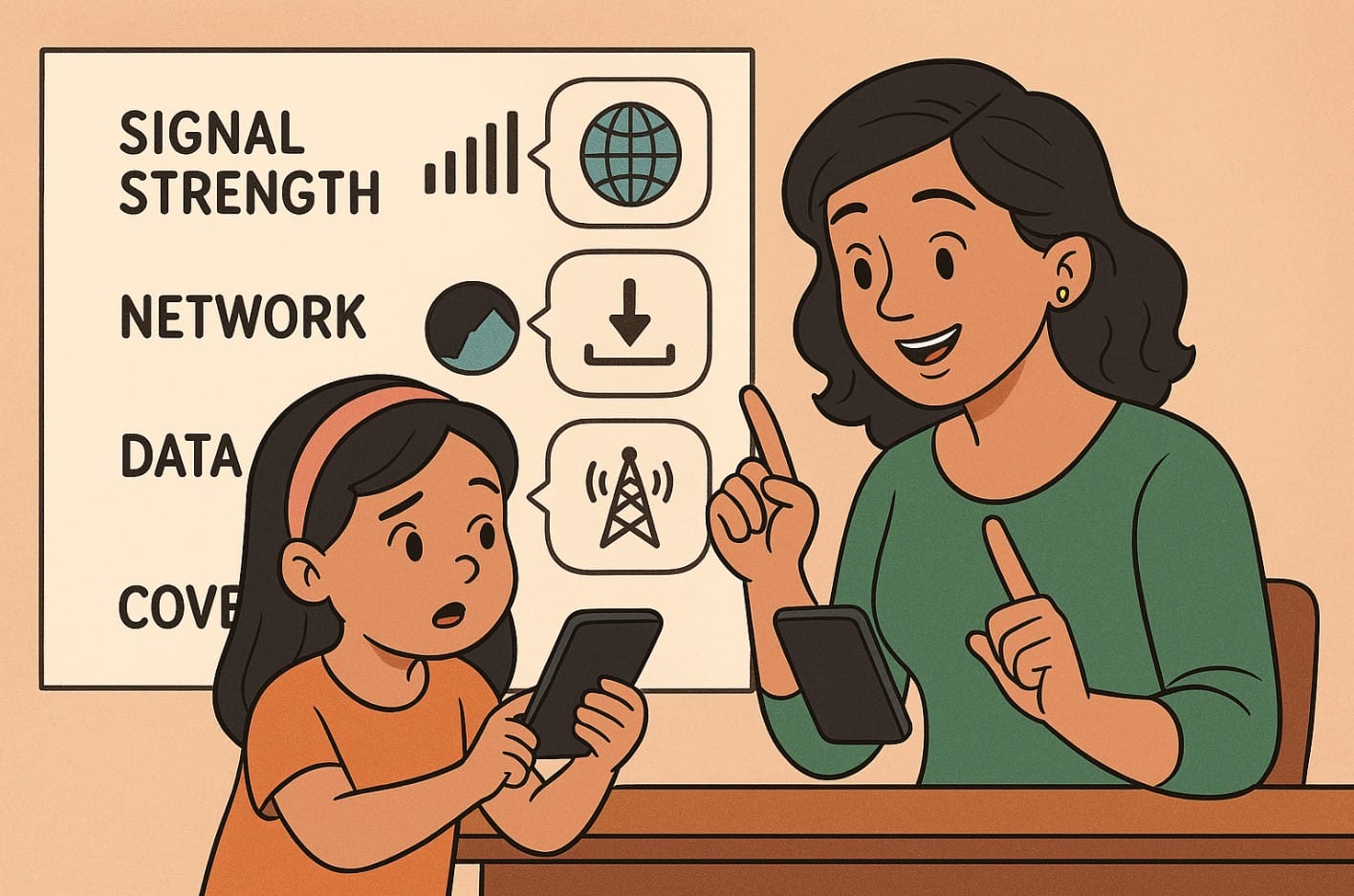
Most people in India recharge their phones without thinking much about the network behind it. If the plan looks good and the signal bars are full, it should work right?
But in reality, your mobile experience depends on more than just your recharge.
Terms like VoLTE, carrier aggregation, network bands, throttling, and 5G priority quietly affect your speed, call quality, and signal even if you’re on a good plan with a powerful phone.
In this guide, you’ll learn what these technical terms actually mean, how they apply to everyday mobile use in India, and why understanding them can help you:
- Avoid common slow-speed frustrations
- Choose better devices or SIMs
- And know when the problem is the network, not your plan
You don’t need to be an expert. Just knowing the basics of how mobile networks work in 2025 can make your daily usage smoother and smarter.
1. What Is Mobile Network Priority?
Network priority decides who gets faster speeds during congestion.
In India:
- Postpaid users often get higher priority than prepaid
- Premium and corporate users are sometimes prioritized during peak hours
- Operators don’t mention this in recharge details but you’ll feel it when the network slows down
If you’re on a prepaid SIM in a busy area, your speed may drop even if you’re on 5G simply because others are given preference.
2. What Are Mobile Network Bands?
Think of network bands like radio frequencies. Your phone connects to a specific band to access 4G or 5G.
Common Indian bands:
- Band 3 (1800 MHz) – Common 4G band used by all operators
- Band 5 (700 MHz) – Long-range, good signal indoors, slower speeds (mostly Jio)
- Band 40 (2300 MHz) – High-speed, short-range, poor indoors
- Band 78 – Primary 5G band for both Jio and Airtel
Your phone needs to support the right bands to get the best speeds. Not all phones support all bands.
3. What Is Carrier Aggregation?
Carrier aggregation lets your phone combine multiple bands at once to improve speed and stability.
- For example: Band 3 + Band 40 = 4G+ or LTE-A
- Not available on entry-level or older phones
- If your phone doesn’t support it, you may get lower speeds, even on the same plan as others
Some phones show “4G+” when this feature is active.
4. What Is VoLTE, VoWiFi, and Dual 4G?
VoLTE (Voice over LTE)
Lets you make calls over 4G instead of dropping to 2G/3G. This means:
- Faster call connection
- Better voice quality
- You can browse while on a call
Available on Jio, Airtel, and Vi.
VoWiFi (Voice over Wi-Fi)
Lets you make calls using your Wi-Fi network when mobile signal is weak.
- Great for indoors, basements, or areas with poor coverage
- Does not use your mobile data
- Supported by most phones and networks (must be turned on in settings)
Dual 4G / Dual SIM Standby
Allows both SIM slots to use 4G at the same time.
- Needed if you want to use one SIM for data, one for calls
- Some phones downgrade one SIM to 2G during calls
5. What Do Signal Bars Actually Mean?
Full bars on your phone only indicate signal strength, not internet speed.
You may have:
- Full bars but poor speed (congestion or slow band)
- Low bars but decent speed (strong band, low user load)
For a true picture, use a speed test app like Speedtest.net, Fast.com to check the signal band and quality.
6. What Is FUP and Speed Throttling?
FUP stands for Fair Usage Policy.
Even in “unlimited” plans, there’s a data limit after which your speed drops drastically:
- Jio drops to 128 kbps
- Airtel and Vi drop to 64 kbps
This is called speed throttling. You can remove it temporarily by using booster packs or waiting for the next day’s reset.
7. What Is Data Rollover, Night Data, and Weekend Binge?
- Data rollover: Your unused postpaid data carries forward to the next month (up to a limit)
- Night data: Unlimited data from 12am to 6am (Vi only)
- Weekend binge: Some Vi plans allow weekday data to be used on weekends
These features are plan-specific, not available in all recharges.
8. What Is SA vs NSA in 5G?
India currently uses NSA (Non-Standalone) 5G:
- Works on existing 4G infrastructure
- Faster than 4G but not true low-latency 5G
SA (Standalone) 5G:
- Pure 5G network
- Lower latency, faster speeds
- Not widely deployed in India yet
You may also see “NR” on your phone it stands for New Radio, the technical name for 5G.
So if your phone shows NR5G, it simply means you’re connected to a 5G network (usually NSA in India).
9. Hotspot Speed Throttling – Why Tethered Devices May Feel Slower
Even when your phone has fast data, your hotspot speed may be limited.
- Many operators throttle hotspot usage after daily FUP
- Some budget plans cap speed on tethered devices
- Vi and Jio have known limits on shared hotspot usage
- USB tethering may give better performance than wireless hotspot
If your laptop or TV feels slow via phone hotspot, this could be the reason.
10. Speed vs Latency – Why Internet Feels Slow Even When Speed Test Says It’s Fast
Speed tests show how much data is downloaded per second (e.g., 20 Mbps), but latency (or ping) decides how fast your apps respond.
- High latency = lag in gaming, video calls, and opening websites
- Vi may have lower latency in some zones, Airtel and Jio more stable speeds
- Low ping = better experience, even if the Mbps is not very high
Look beyond Mbps when diagnosing slow internet check your ping too.
11. Should You Care About These Terms?
Yes but only if you want to fix slow speeds, choose the best operator, or get full value from your plan.
| Term | When It Matters |
|---|---|
| Network priority | If your speed slows during peak hours |
| Bands & aggregation | If your 5G/4G feels slower than expected |
| VoWiFi | If calls drop indoors |
| Signal bars | Misleading – use speed tests instead |
| FUP | If data slows suddenly |
| Hotspot throttling | If you work remotely or share data |
| Latency | If you game or video call frequently |
| SA vs NSA | Only relevant for future-proofing or tech-savvy users |
12. Know Your Network, Not Just Your Plan
You don’t need to remember every technical term in this guide but understanding the basics can save you time, money, and frustration.
When your internet feels slow, your calls drop, or your hotspot isn’t working right, the issue often isn’t your plan. It could be:
- The band your phone is using
- Whether your SIM gets network priority
- Or something as simple as FUP limits or signal congestion
By knowing how mobile networks actually work in India even at a basic level you can troubleshoot faster.

