
How Graphics Card Shaped India’s Computing: Gaming, AI, and Beyond
Why GPUs Became More Than Just Gaming Hardware?
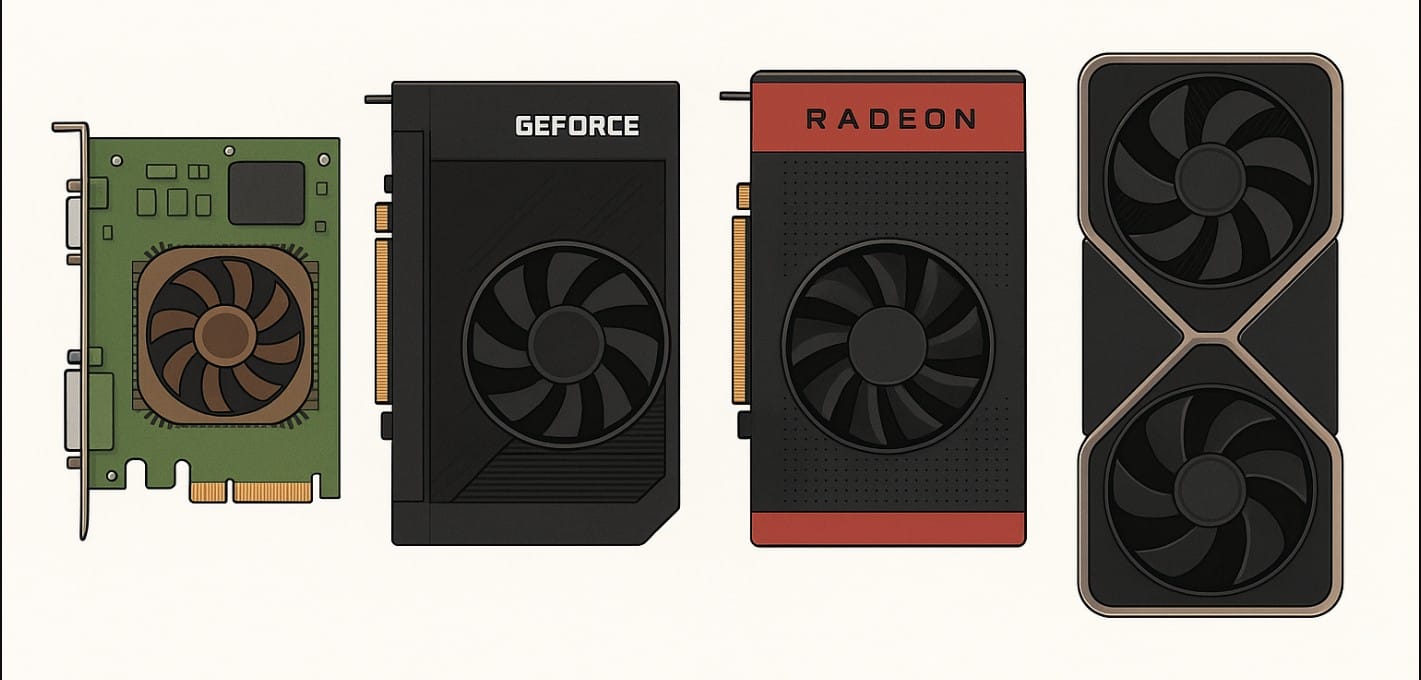
Graphics cards have always been seen as the “gaming part” of a computer, but their role has expanded far beyond that. In the last decade, NVIDIA GeForce and AMD Radeon GPUs have become central to workloads as diverse as AI research, machine learning, animation, and even cryptocurrency mining. Globally, GPUs now compete with CPUs as the most important hardware in computing.
In India, the story has been shaped by different realities. Most gamers play on smartphones, so discrete GPUs never became a mass-market product. Instead, they found their place in niche but influential communities, esports cafés, DIY PC builders, and professional creators. At the same time, universities and AI startups began to depend on GPUs for deep learning, though high prices and limited availability meant many had to rely on cloud GPU rentals instead of buying hardware.
This article looks at how NVIDIA and AMD GPUs rose in India, starting from their entry through gaming, moving through the crypto mining boom, and now powering the country’s AI ambitions and where the market is heading by 2028.
Gaming as the First Driver of GPU Adoption in India
Entry Through Gaming in the 2000s
The first real push for dedicated GPUs in India came from gaming. In the early 2000s, NVIDIA GeForce and AMD Radeon cards began to appear in DIY desktop builds and pre-assembled OEM systems sold in metros. For most households, integrated graphics on CPUs were still enough for browsing, office work, or running Tally, but gamers quickly realized that discrete GPUs were the only way to play titles like Counter-Strike, Age of Empires, or Need for Speed at acceptable frame rates.
Internet Cafés and Esports Centers
Internet cafés played a central role in this growth. As gaming cafés became popular across Tier-1 and Tier-2 cities, owners invested in affordable mid-range GPUs to ensure smoother performance in multiplayer titles. LAN gaming tournaments often ran on bulk setups of GeForce 6600 or Radeon 9600 cards, which balanced cost with reliable frame delivery. These cafés exposed a generation of students and young professionals to the idea that a “real gaming PC” needed a GPU.
Why GPUs Stayed Niche at First
Despite this growing awareness, GPU adoption in Indian homes remained limited. Pricing was a major barrier, as import duties and currency fluctuations made even mid-range GPUs significantly more expensive compared to the West. Many families prioritized affordability and chose CPUs with integrated graphics for everyday use. Only dedicated gaming enthusiasts were willing to spend extra on discrete cards.
Limited Professional Use
Outside gaming, GPUs had a narrow footprint in India during this period. A handful of animation studios, CAD designers, and universities invested in professional-grade GPUs like NVIDIA Quadro or AMD FirePro for 3D rendering and engineering simulations. These were niche cases, often tied to specialized industries or research labs. For the wider population, GPUs were seen as non-essential add-ons rather than core components.
India’s Shift in AI Computing: Why Graphics Card Became Critical (2016-2025)
AI Research and Startup Demand
By the mid-2010s, artificial intelligence and machine learning had moved from niche academic fields to mainstream research and business applications. This shift exposed a limitation of CPUs: they excelled at sequential tasks but struggled with the parallel processing needed for training large models. GPUs, with thousands of cores optimized for parallel workloads, became the backbone of deep learning.
In India, this transition was visible across multiple fronts:
- Research Institutes: IITs, IISc, and IIITs began shifting from traditional CPU clusters to GPU-based servers for computer vision, speech recognition, and natural language processing research.
- Startups: New AI-focused companies in Bengaluru, Hyderabad, and Gurugram adopted GPUs to build products in healthcare analytics, fintech, autonomous systems, and language AI for Indian languages.
- Industry: Larger firms in IT services and telecom invested in GPU infrastructure to experiment with machine learning, cloud services, and recommendation systems.
For these groups, CPUs were no longer enough. Training even a moderately sized deep learning model on CPUs could take weeks, whereas GPUs cut that time to days or hours.
NVIDIA’s Early Lead
NVIDIA secured a dominant position in AI because of its CUDA platform, a software ecosystem that made it easier for developers to write code optimized for GPUs. CUDA became the default for AI research, locking most institutions and startups into NVIDIA hardware.
As a result, NVIDIA’s high-performance GPUs such as the RTX A6000, A100, and more recently the H100, became the gold standard for AI work. In India, however, these cards are rarely bought by individuals or small labs due to their price, often running into several lakhs of rupees per unit. Instead, they are imported by universities, large corporations, or datacenter providers.
AMD tried to enter this space with ROCm (its open GPU compute ecosystem), but its adoption in India remains limited compared to CUDA, which has deeper software and developer support.
Barriers in India
Despite strong interest in AI, several challenges make GPU access difficult in India:
- High Prices: Import duties, GST, and the weaker rupee push GPU prices up by 25-40% compared to the US or Europe. A GPU that retails at $10,000 abroad can easily exceed ₹12-15 lakh in India once landed costs are included.
- Limited Distribution: Only a handful of distributors manage high-end GPU imports. Stock is unpredictable, leading to long waiting times for universities or startups that need multiple units.
- Cloud Dependency: Because of high upfront costs, many Indian startups and research labs turn to cloud GPU rentals instead of buying hardware. Global providers like AWS and Azure offer access to A100 and H100 instances, while domestic firms such as Yotta, Netmagic, and E2E Networks have started offering Indian-hosted GPU servers. This allows smaller teams to experiment with AI without the massive upfront investment.
PC Gaming and the Role of GPUs in India
Mobile vs PC Gaming
In India, the majority of gamers play on smartphones because they are far more affordable than a full desktop setup. Titles like BGMI, Free Fire, and Call of Duty Mobile reach millions of players without the need for discrete GPUs. This means that, unlike in the US or Europe, gaming is not the primary mass-market driver for GPU demand in India.
Niche But Visible PC Gaming
Where discrete GPUs do play a role is in niche but visible segments:
- Esports on PC: Competitive titles such as Valorant and Counter-Strike 2 are popular in urban esports cafés and among enthusiasts who build DIY systems. These setups require mid-range GPUs to sustain high frame rates at 1080p or 1440p.
- Home Enthusiasts: A smaller but growing community of gamers in Tier-1 and Tier-2 cities invests in desktops with mid-range NVIDIA GeForce or AMD Radeon cards. For these buyers, GPUs are the single most critical part of the build.
Gaming Cafés and Community Builds
Esports cafés remain one of the most visible buyers of bulk GPU setups in India. Owners typically choose reliable mid-range cards that balance cost with longevity. Alongside this, a community resale market makes refurbished GPUs available to students and budget-conscious buyers.
Reality Check
Despite these visible pockets, PC gaming is still a minority compared to mobile gaming in India. For every desktop gamer building a GPU-based system, thousands of players are active on smartphones. This means that while gaming does sustain GPU demand in India, it is secondary to AI workloads globally and limited in scale locally.
When Crypto Took Over GPUs, and What Happened After
The Boom Years: 2017 and 2020-21
Globally, Ethereum mining caused massive GPU shortages, and India was no exception. However, India’s mining scene looked very different compared to large-scale farms in the US, China, or Eastern Europe.
- Small-Scale Rigs: Most Indian miners operated small to medium rigs, often with 4-20 GPUs, set up in rented rooms, hostels, or warehouse spaces. Few had the resources for industrial-scale farms due to high commercial electricity rates and limited infrastructure.
- Cheaper Power Pockets: Some miners thrived in regions with subsidized or cheaper electricity, such as certain rural or semi-urban areas. In states with relatively low power tariffs, ROI calculations made mining just viable enough to attract individuals.
- Impact on Gamers: Even mid-range GPUs like the GTX 1660 Super, RTX 2060, and Radeon RX 580 were hoarded for mining because of their strong hash-per-watt efficiency. As a result, retail gamers in India struggled with inflated GPU prices, and stock shortages were common in major hubs like Nehru Place (Delhi) and Lamington Road (Mumbai).
- Grey Imports: Parallel import channels brought additional GPUs into India during the boom. Many lacked proper warranty, but miners didn’t mind since they prioritized upfront hash rate over long-term reliability.
The Bust and Resale Flood After 2022
When Ethereum shifted to Proof-of-Stake (PoS) in 2022, GPU mining profitability collapsed almost overnight. In India, this caused a wave of ex-mining GPUs hitting the second-hand market.
- Sudden Oversupply: Local markets in Delhi, Ahmedabad, and Bengaluru saw large numbers of used GPUs, from entry-level GTX 1060s to high-end RTX 3080s. Prices dropped rapidly, making them attractive for budget-conscious gamers and small businesses.
- Affordability vs Risk: For many students and café owners, these ex-mining cards provided the only way to access high-end GPU performance at half or even one-third the retail price. But risks were high:
- Reduced Lifespan: Mining cards typically ran 24/7 at high loads for years, reducing long-term durability.
- Cooling Issues: Many were modified with aftermarket fans or had degraded thermal pads.
- No Warranty: Most came without bill or warranty, leaving buyers exposed.
Long-Term Impact
- Cautious Buyers: Over time, Indian buyers became more cautious about ex-mining GPUs. Forums and communities started sharing ways to test cards for stability before purchase.
- Market Distortion: The influx of cheap second-hand GPUs temporarily depressed demand for new mid-range GPUs in India, as many gamers chose cheaper used cards over full-price retail ones.
- Resale Culture Strengthened: Mining indirectly boosted India’s already strong second-hand PC parts culture, making GPUs one of the most liquid components in local markets.
Graphics Card Market Dynamics: India vs Global
The Pricing Gap
GPU prices in India are consistently higher than in the US or Europe. A card like the RTX 4070, which retails for around $600 internationally, often lands in India at ₹55,000-60,000 or more. The difference comes from multiple layers of cost:
- Import Duties and GST: Together, these taxes add nearly 18-28% to the base price.
- Currency Weakness: Fluctuations in the rupee against the dollar amplify the gap whenever the dollar strengthens.
- Logistics and Distribution: Limited import volumes and additional handling by distributors further raise retail prices.
For Indian buyers, this means GPUs are rarely priced at their global “suggested retail value,” making mid-range cards feel premium and high-end cards nearly out of reach.
Distribution and Warranty Challenges
Unlike laptops, which have widespread brand service networks, GPUs rely on fewer distributors and third-party service providers. This creates uneven access to warranty and after-sales support.
- Tier-1 Cities: In places like Delhi, Bengaluru, and Mumbai, RMA (Return Merchandise Authorization) processes are relatively smooth through established distributors.
- Tier-2 and Tier-3 Cities: Access is far weaker. Buyers often need to ship GPUs to metros for servicing, which adds delays and costs.
- Risk Factor: For customers outside metros, the lack of dependable warranty coverage makes buying a new GPU riskier, pushing some to delay purchases or rely on laptops instead.
What India’s GPU Future Looks Like (2025-2028)
AI as the Primary Growth Driver
Globally, AI is already the main force behind GPU demand, and this will only intensify. In India, the picture looks different: instead of mass ownership, demand will show up through cloud access. Startups, universities, and enterprises will increasingly rent GPU power from domestic datacenters rather than purchase multi-lakh hardware. NVIDIA and AMD GPUs are becoming infrastructure assets here, not consumer products.
Gaming as a Niche but Resilient Segment
While smartphones dominate India’s gaming landscape, desktop GPUs will stay relevant in specific niches:
- Esports cafés in Tier-1 and Tier-2 cities that require consistent high frame rates.
- Enthusiast home builders who prioritize performance beyond what gaming laptops can offer.
This market will remain small in volume but visible in influence, since these are the communities that drive PC hardware discussions in India.
Cloud GPU Expansion in India
Domestic datacenter providers such as Yotta, E2E Networks, and Reliance Jio’s cloud arm are scaling GPU-backed services. By 2027, more Indian developers and SMEs are expected to access GPUs through these platforms instead of importing hardware. This makes GPU use more democratized but also shifts focus away from physical ownership.
Policy and Manufacturing Hopes
“Make in India” may expand local assembly of GPU-powered servers and PCs, but the chips themselves will continue to be imported. Without semiconductor fabs in India, pricing relief for high-end GPUs will remain limited. At best, logistics and distribution efficiency may shave costs slightly, but the structural gap with global pricing will stay.
The Likely Landscape by 2028
- AI-first workloads dominate demand, with GPUs treated as datacenter resources.
- Gaming remains visible but niche, driven by esports cafés and enthusiasts.
- GPU ownership shrinks, while GPU access grows through cloud platforms.
- Pricing gap persists, making high-end consumer GPUs aspirational rather than mainstream.
India’s GPU Story: Between Affordability and Innovation
The journey of Graphics Card in India reflects how global technology trends adapt to local realities. For gamers, NVIDIA and AMD cards have always symbolized performance, whether in internet cafés or DIY desktops. For AI researchers and startups, GPUs are now indispensable, though often accessed through cloud rentals rather than direct ownership. And for a brief period, crypto mining reshaped availability and pricing, leaving behind lessons about volatility and risk.
As India moves into the second half of this decade, GPUs will remain essential but unevenly distributed. AI workloads will dominate demand at the institutional level, while gaming communities keep discrete GPUs visible in consumer markets, even if mobile continues to rule the mainstream. Pricing gaps with global markets will persist until India builds a stronger semiconductor ecosystem, but cloud access is already making GPUs more accessible to smaller teams and developers.
For Indian buyers, the GPU has shifted from being just a luxury add-on for gaming to becoming a symbol of advanced computing power, critical to AI, creative work, and innovation. The next few years will decide how widely this power can spread across the country.

