
Microwave Capacity in Litres – What It Means & How Much You Actually Need
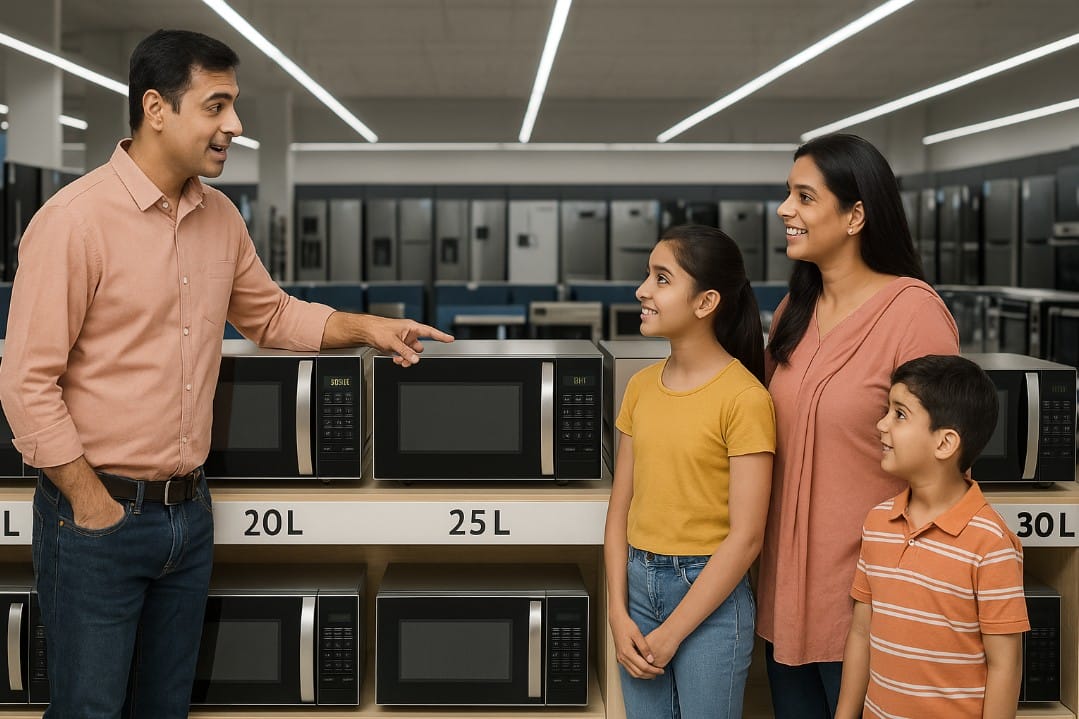
Buying a microwave in India often starts with one confusing number – capacity in litres. But how many litres do you actually need? Will a 20L microwave be enough to reheat food for a family of four? Is a 30L microwave too big for a couple?
Microwave ovens aren’t just for heating. Many Indian families now use them to grill sandwiches, bake birthday cakes, or even cook full meals. So choosing the right size matters – not just for performance, but also for space, electricity, and convenience.
This guide helps you understand what microwave capacity means, how to pick the right one for your family size and cooking style, and what to watch out for while buying, especially in Indian kitchens.
1. What Does Microwave Capacity Mean?
Microwave capacity is measured in litres (L) – it represents the total internal volume of the cooking chamber. But don’t be misled:
- A 25L microwave doesn’t mean you can cook 25 litres of food at once.
- It’s about the space available inside for utensils, food, and airflow.
Also, different types of microwaves (solo, grill, convection) use space differently.
For example:
- A grill microwave includes a heating coil at the top – reducing usable height.
- A convection microwave needs airflow around food – so crowding is not ideal.
2. Why Microwave Oven Size Matters in Indian Homes
In Indian kitchens, you often deal with:
- Deep stainless-steel bowls
- Microwave-safe glassware
- Flat steel thalis
- Steamers, idli makers, or baking tins
If the microwave is too small:
- Thalis won’t rotate properly
- Tall bowls may not fit
- You’ll struggle to grill or bake evenly
That’s why capacity directly affects convenience – not just cooking ability.
3. Family Size vs Microwave Oven Capacity: Simple Breakdown
| Household Type | Recommended Capacity | What You Can Do Comfortably |
| Single / Hostel Room | 17L – 20L | Reheat, defrost, light cooking |
| Couple | 20L – 23L | Heat meals, cook small portions, grill |
| Family of 3-4 | 23L – 28L | Heat + Grill + Bake small cakes/pizzas |
| Family of 5+ | 28L – 32L+ | Multi-dish cooking, full meals, baking |
4. Real-Life Indian Examples (By Size)
17L – 20L Microwave
- Good for: Reheating roti, rice, dal, milk
- Not great for: Grilling or baking
- Utensils: One medium bowl at a time
- Best for: Students, bachelors, people who mostly eat outside
21L – 25L Microwave
- Good for: Small families reheating 2-3 dishes
- Can grill a sandwich or 2-3 paneer skewers (grill model)
- Can bake small cakes (convection model)
- Best for: Couples, nuclear families
26L – 30L Microwave
- Can heat, grill, and bake in full portions
- Can fit two medium containers or one large curry bowl
- Suitable for tandoori cooking or baking in larger tins
- Best for: Families of 3-4 who cook often at home
30L+ Microwave
- Can cook multiple dishes in one cycle
- Ideal for full-size cakes, lasagna, baked dishes
- Can fit idli steamer, large thali, and flat pans
- Best for: Joint families, cooking lovers, or those who batch-cook meals
5. Check Your Utensil Fit Before Buying
Take your most-used cookware and measure its width and height.
Now compare it with the microwave’s internal dimensions, which are often listed in product specs.
Common utensil sizes:
- Glass bowl: 20-25 cm wide
- Round steel thali: 28 cm diameter
- Cake tin: 7-8 inch round pan
Your microwave should allow free rotation without scraping the walls. If it doesn’t – size up.
6. Mistakes to Avoid
- Buying too small for your future needs
(e.g., planning to bake but choosing a solo model with 20L) - Not checking usable space
– Grill and convection models reduce height due to coils or fans - Ignoring your utensil size
– Steel katoris and large bowls may not rotate in 17L ovens - Forgetting about future cooking habits
– Many first-time users eventually start using grill or bake modes
Conclusion: Your Microwave Oven Capacity Sweet Spot
Microwave capacity isn’t just a number – it’s about your kitchen lifestyle. For most Indian families, 23L to 28L hits the sweet spot between functionality and convenience.
Choose smaller if you mostly reheat. Go bigger if you grill, bake, or cook full meals. And always check your common utensils before buying.
A well-sized microwave oven saves time, fits your cooking tools, and actually encourages you to use it more often – the way it should.

