
From Supercomputers to Aadhaar: India’s Computing Story
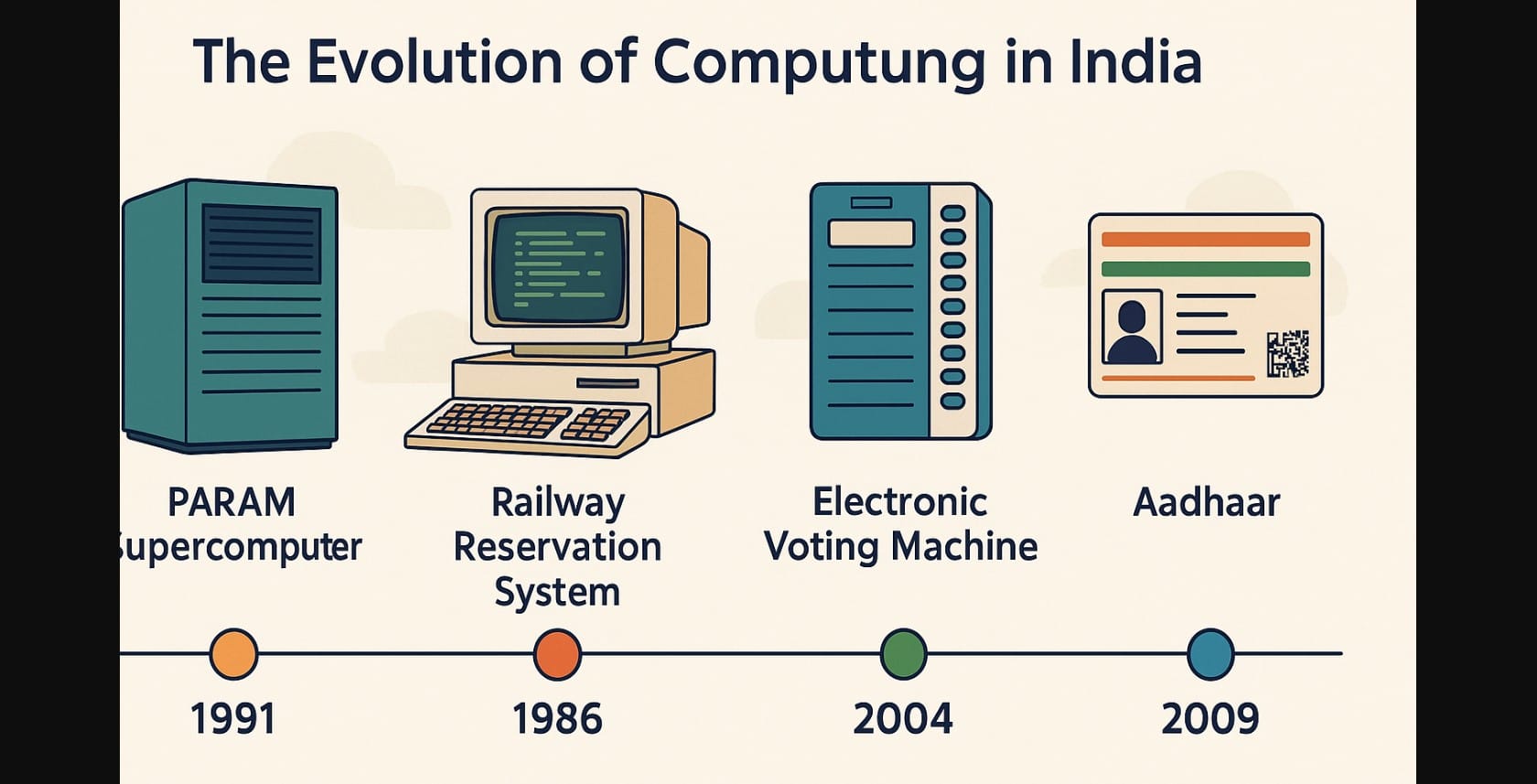
When you think about computers in India, the first images that often come to mind are outsourcing hubs, software exports, or rows of IT professionals coding for global firms. But India’s role in computing goes far deeper than that narrow picture. Over the last four decades, the country has taken unexpected paths building its own supercomputer when global powers shut the door, rolling out electronic voting across the world’s largest democracy, and creating Aadhaar, the biggest biometric identity project ever attempted.
These are not just milestones; they are lessons that have challenged assumptions about who leads in computing, how technology can scale, and what role affordability and inclusion play in shaping innovation. From PARAM in the early 1990s to Aadhaar and UPI today, India’s computing story continues to surprise the world.
These milestones reveal how computing here isn’t just about technology but about self-reliance, affordability, and inclusivity.
1. Supercomputing Against the Odds – The PARAM Story
In the late 1980s, India wanted to buy a Cray supercomputer from the United States. The request was denied due to fears it could be used for nuclear research. Instead of giving up, India’s Centre for Development of Advanced Computing (C-DAC) built PARAM 8000 in 1991.
This achievement made India one of the very few nations with its own indigenous supercomputing capability. More importantly, it sent a global message: restrictions can fuel innovation.
2. Microprocessor Independence – Shakti and Vega
While most microprocessor design has been dominated by companies in the US and East Asia, India entered the field with Shakti (developed at IIT Madras) and Vega (from C-DAC). These processors are open-source and focus on security and customization for local needs.
By designing chips in-house, India showed that even in one of the most complex areas of computing, independence is possible. This lesson resonates globally, especially in an era of supply chain vulnerabilities.
3. Railways and Reservation Systems – Computing for the Masses
In the 1980s, Indian Railways introduced computerized ticket reservations. For the first time, people could book tickets without relying entirely on paper records. By the 1990s, real-time booking systems linked multiple cities.
This was not just convenience. It was one of the largest public-facing automation projects in the world at that time. Millions experienced computers not in labs or offices, but at railway counters. It proved that large-scale computerization could directly touch ordinary lives.
4. Aadhaar – The World’s Largest Biometric System
With over 1.3 billion people enrolled, Aadhaar is the largest biometric identity project ever attempted. It uses fingerprints, iris scans, and demographic data stored in massive computing systems.
The lesson here is scale. While other countries experiment with national IDs, India rolled out a system that covers nearly its entire population. It showed how computing infrastructure could be applied not just for security or research but for social inclusion.
5. Voting Machines – A Different Path in Democracy
India has relied on electronic voting machines (EVMs) nationwide since 2004. Each device is simple, battery-operated, and designed to work in villages without reliable electricity.
For the world’s largest democracy, this was a unique choice. The lesson is that robust computing doesn’t always mean complexity. Sometimes, low-cost, resilient design is what makes technology successful at scale.
6. Cyber Cafés and Jugaad Computing Culture
In the late 1990s and 2000s, cyber cafés were the gateway to the internet for millions of Indians. For a few rupees an hour, students could check email, fill forms, or play games.
These cafés became digital classrooms long before schools had computers. They also represent India’s “jugaad” culture, using limited resources to create maximum impact. The world learned that democratizing technology isn’t only about owning a computer, but about shared access.
7. Government Adoption Gaps – The Floppy Disk Problem
Even as India advanced in many areas, government departments sometimes lagged behind. Into the 2010s, some tenders and forms still referenced floppy disks.
This mismatch highlights the challenge of updating digital systems across a vast bureaucracy. The lesson is sobering: computing progress is uneven, and modernization requires more than just new technology, it needs systemic reform.
8. Scale of Digital Payments and UPI
India’s Unified Payments Interface (UPI) has transformed money transfers. Every month, UPI now processes more transactions than Visa and Mastercard in India combined. What makes this surprising is its simplicity, just mobile apps connected through open APIs.
This approach leapfrogged older systems like credit cards. It taught the world that when computing platforms are built for scale and openness, adoption can be faster than expected.
9. Lessons from India’s Computer Story
- Innovation under pressure: PARAM showed that global restrictions can lead to local breakthroughs.
- Scale and inclusivity: Aadhaar and UPI proved computing can work at billion-plus scale.
- Simplicity matters: From EVMs to cyber cafés, India demonstrated that low-cost, resilient systems are sometimes more powerful than cutting-edge ones.
- Gaps remain: The floppy disk era reminds us that digital adoption in large systems is uneven and slow.
Summary – India’s Computer Story
India’s computer journey shows that technology is not only about faster processors or advanced hardware, but about how computing adapts to the needs of society. From PARAM supercomputers built under sanctions to Aadhaar’s billion-plus identity system, and from railway reservations to UPI payments, India has consistently used computers in unexpected ways. Some choices came from necessity, some from ambition, and some from sheer scale.
The lesson for the world is clear: computing breakthroughs do not always emerge from the richest labs or the most advanced economies. Sometimes they come from solving real-world challenges for millions of people, in environments where cost, accessibility, and resilience matter more than raw power. India’s story quirky at times, inspiring at others is a reminder that computers are most transformative when they meet the realities of the people who use them.
India, often seen as an outsourcing hub, has changed computing in unique ways that have both local and global effects, offering important lessons to observe.

