
Don’t Overbuy or Undersize: How to Choose the Correct Inverter Battery Capacity
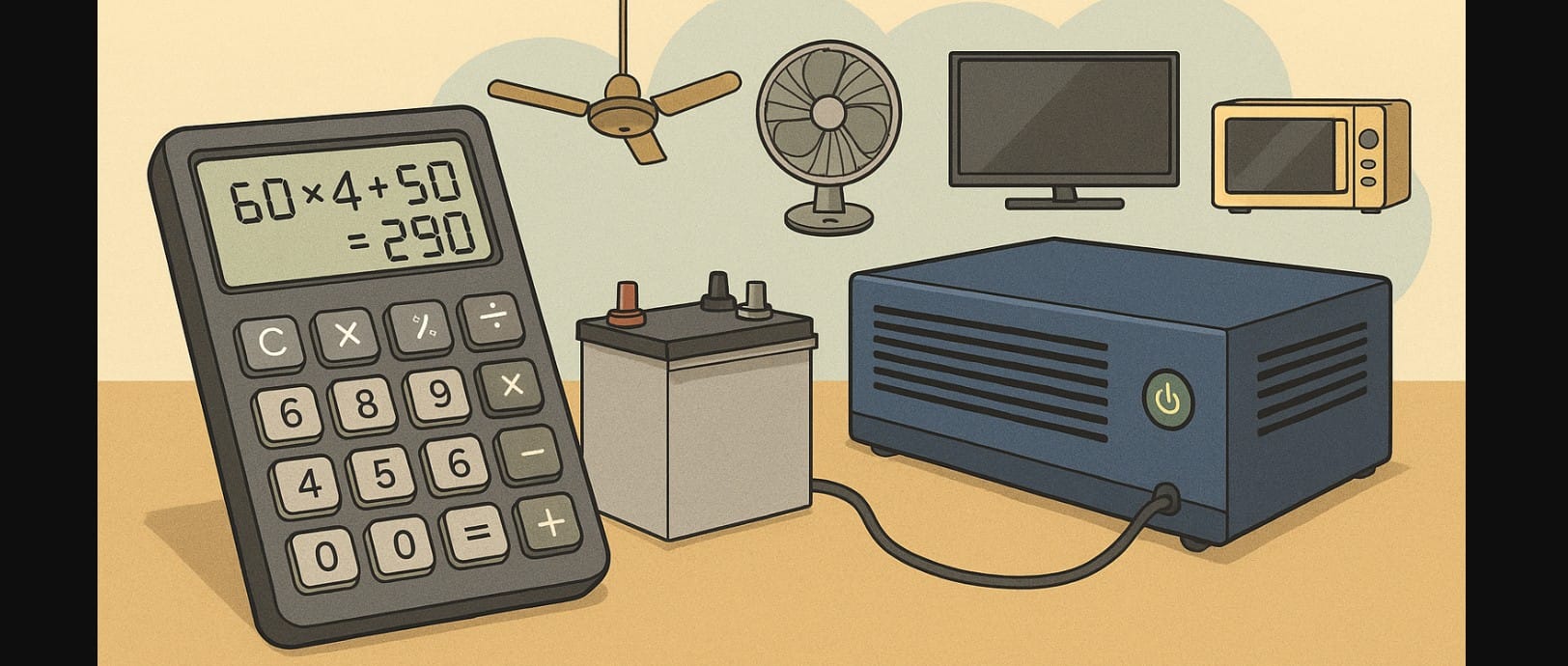
A 150Ah battery may not provide sufficient power. Often, it lasts less than 90 minutes for backup.
The problem is not the brand, but the mismatch between your power needs, duration, and the battery’s capabilities.
Most households skip the math and go with whatever is commonly sold. This leads to:
- Shorter backup than expected
- Frequent overload shutdowns
- Batteries that wear out in under 2 years
Let’s change that. Here’s a step-by-step method to get the right battery size based on your actual power needs.
1. Start by Listing Everything You Need During a Power Cut
Use this table to write down only what you plan to run not everything in the house.
| Appliance | Power Rating (Watts) | Quantity | Total Power (W) |
|---|---|---|---|
| Ceiling Fan | 70W | ||
| LED Tube Light (4ft) | 20W | ||
| LED Bulb | 9W | ||
| Wi-Fi Router | 15W | ||
| 32-40 inch LED TV | 80W | ||
| Fridge (running cycle) | 150W | ||
| Laptop Charger | 60W |
Example calculation for a typical 2BHK:
- 3 fans = 3 × 70 = 210W
- 4 tube lights = 4 × 20 = 80W
- 1 router = 15W
- 1 TV = 80W
- 1 fridge = 150W
Total = 535W
2. Decide How Long You Need This Load to Run
This depends on your local blackout situation:
- Short daily cuts (30-60 minutes)?
- Long irregular cuts (2-3 hours)?
- Rural or edge-of-grid zone with 4-6 hour outages?
Let’s say you want this load to run for 2.5 hours.
3. Use This Formula to Find Battery Capacity in Amp-Hours (Ah)
Step 1: Multiply Total Load by Backup Time
535W × 2.5 hours = 1,337.5 Wh (watt-hours)
Step 2: Account for System Voltage and Efficiency
Use 12V if your inverter uses a single battery.
Use 24V if you have a dual battery setup.
For 12V lead-acid:
Ah = Wh / (12 × 0.8) = 1,337.5 / 9.6 ≈ 139Ah
For 24V lead-acid:
Ah = 1,337.5 / (24 × 0.8) = 1,337.5 / 19.2 ≈ 70Ah (x2 batteries = 140Ah total)
Choose the next standard size: A 150Ah battery is ideal here.
4. Inverter Battery Size Guide Based on Actual Load and Usage
| Load (W) | Hours Needed | Total Energy (Wh) | Battery Size (Ah at 12V) |
|---|---|---|---|
| 250W | 2 hours | 500Wh | 52Ah |
| 400W | 2 hours | 800Wh | 84Ah |
| 500W | 3 hours | 1,500Wh | 156Ah |
| 600W | 4 hours | 2,400Wh | 250Ah |
Use 24V systems if your total Ah requirement crosses 180-200Ah.
5. Examples for Common Homes
1BHK with Lights, Fan, Router – 2-hour backup
- Load: ~200W
- Battery: 100Ah lead-acid (12V) or 60Ah lithium
2BHK with TV, Fridge, 3 Fans – 3-hour backup
- Load: ~500W
- Battery: 180-200Ah lead-acid (12V) or 100-120Ah lithium
House with Solar Inverter, Daily Cycling
- Load: ~300W
- Backup needed: 4 hours
- Battery: 100Ah lithium-ion at 24V with solar-compatible BMS
6. If You Don’t Match Battery Load and Backup Duration:
- Lead-acid batteries get discharged too deeply, reducing their lifespan
- Inverter shuts off early when battery voltage drops under load
- Frequent topping up and replacement every 18-24 months
- Expensive lithium battery wasted if the load is too low or inverter incompatible
7. What Else Affects Battery Performance
- Discharge limit: Lead-acid shouldn’t drop below 50% charge; lithium can go up to 90%
- Temperature: Batteries lose efficiency in heat ventilated storage helps
- Age: Batteries lose capacity every year account for at least 15% headroom
- Appliance type: Avoid running high-draw devices like irons, washing machines, or mixer-grinders
8. Calculate Battery Backup the Right Way
Here’s how you stay powered during blackouts:
- List essential appliances
- Multiply total wattage by the backup time
- Divide by (voltage × efficiency) to get the minimum Ah
- Choose a battery at or slightly above that number
This method works for any living situation, whether it’s a small flat, a bungalow with solar panels, or a rural home with frequent outages. It helps prevent overpaying, underpowering, or changing batteries too early.

