
LCD, LED, and OLED Screens: What’s Really Different
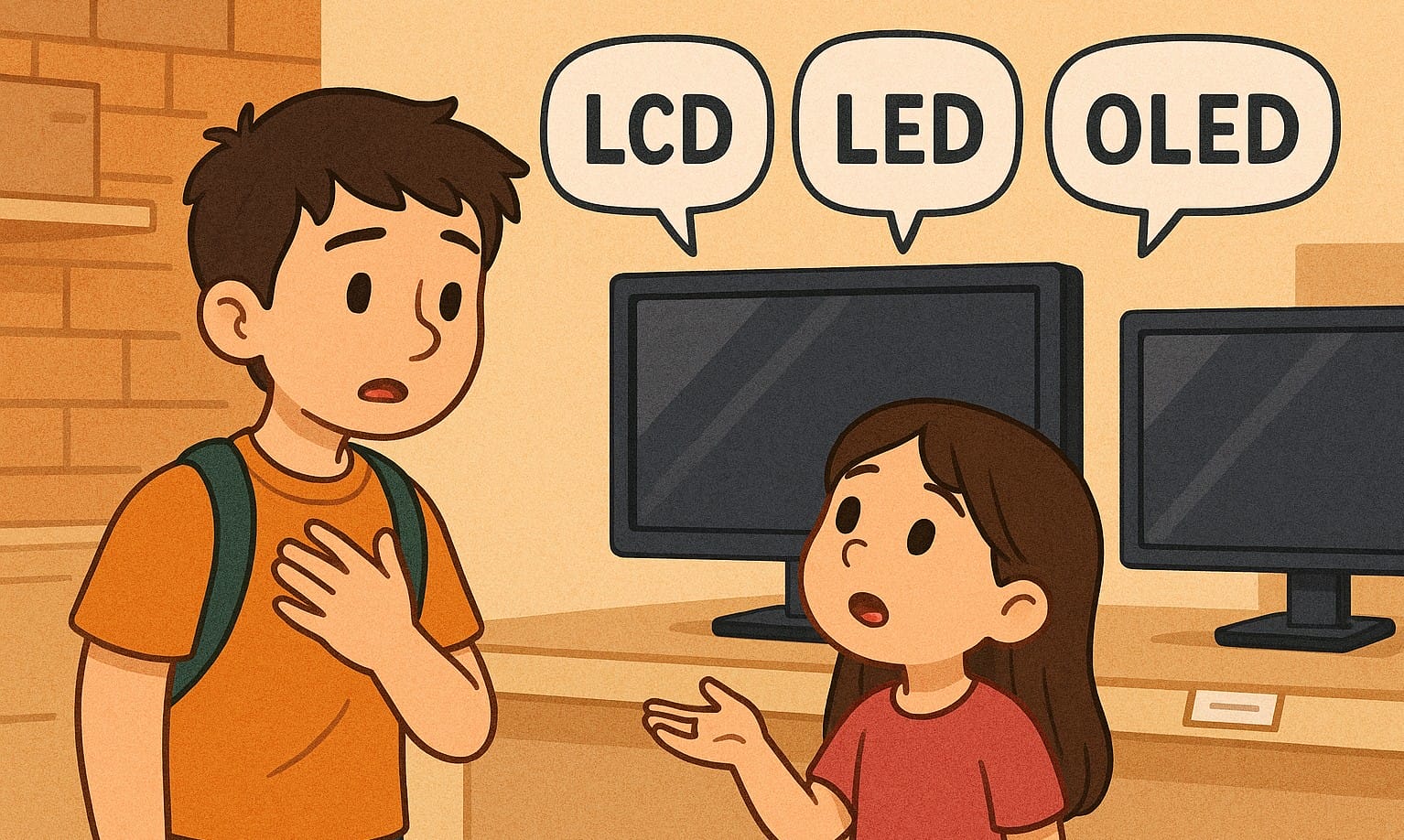
Most people in India buy a monitor or TV without thinking much about what’s behind the screen. You’ll see words like LCD, LED, or OLED and assume newer is better. But what do these terms actually mean? And which one should you care about for your eyes, your usage, and your budget?
This guide breaks it down clearly. You’ll understand how these technologies work, how they differ, and which one makes the most sense for your home or work setup in India.
1. What’s the Real Difference Between LCD, LED, and OLED Screen?
Let’s start with one key fact:
- LED and LCD are not two separate types.
- Almost all “LED monitors” sold today in India are actually LCD screens with LED backlighting.
So technically:
- LCD = The screen technology (liquid crystals)
- LED = The type of backlight used for LCD
- OLED = A completely different screen technology that doesn’t need backlighting
2. LCD (Cold Cathode Backlight) – The Outdated Tech
Old LCD monitors used CCFL (Cold Cathode Fluorescent Lamps) for backlighting. These are bulkier, consume more power, and aren’t widely sold anymore in India.
You’re unlikely to find a new CCFL-backlit monitor in 2025.
Still, many people use the term “LCD” generically for all non-OLED displays. But today, when you buy a monitor in India, you’re almost certainly buying an LED-backlit LCD.
3. LED (Backlit LCD) Monitor – The Current Standard in India
These are by far the most commonly available monitors and TVs in India today.
A regular LCD panel displays the image, while LEDs behind or around the panel light it up.
There are two main types:
- Edge-lit LED: LEDs placed along the edges of the screen (more common and affordable)
- Backlit (Direct-lit) LED: LEDs directly behind the panel (better brightness and uniformity)
Benefits:
- Slimmer, lighter design
- More energy-efficient than CCFL LCDs
- Brighter displays with better contrast
- Affordable and widely available in India
Limitations:
- Can’t achieve true blacks (some backlight always bleeds)
- Limited contrast compared to OLED
- Colors depend heavily on panel type (TN, IPS, or VA)
4. OLED Monitor – The New Premium Choice
OLED (Organic Light Emitting Diode) is a different beast. Here, each pixel emits its own light. That means no need for a backlight at all.
- True blacks: Pixels turn off completely
- Superior contrast: Infinite contrast ratio
- Amazing color accuracy and viewing angles
- Thinner and more flexible panels
- Fast response times (great for gaming)
Limitations:
- Much more expensive (₹75,000 and up for good OLED monitors)
- Risk of burn-in (if the same image stays too long)
- Limited options in India right now for monitors (more common in premium TVs)
5. LCD vs LED vs OLED Monitor Comparison
| Feature | LCD (CCFL)* | LED (LCD with LED) | OLED |
|---|---|---|---|
| Backlight | CCFL tubes | LED light sources | No backlight (self-lit) |
| Brightness | Lower | High | High |
| Contrast | Poor | Good | Excellent (true black) |
| Power Use | High | Efficient | Efficient (dark images) |
| Slim Design | No | Yes | Ultra-slim |
| Burn-in Risk | No | No | Yes (if static image stays) |
| Price in India | Mostly discontinued | ₹7,000-₹35,000+ | ₹75,000 and above |
| Best For | Outdated setups | Most home/work/gaming use | High-end creators/gamers |
*Traditional CCFL LCDs are no longer sold in India. All new “LCD” monitors use LED backlights.
6. Which Monitor Screen is Best for Your Eyes?
If you spend long hours working or studying:
- LED monitors with flicker-free and blue light filter are the safest bet
- Choose IPS panels for better clarity and color
If you’re a content creator or premium gamer:
- OLED gives you unmatched image quality and eye comfort
- But it’s best for mixed-use, not static tasks (to avoid burn-in)
If you’re a casual user or on a budget:
- A standard LED-backlit IPS monitor is more than enough
- Just avoid TN panels if you care about colors or viewing angles
7. Real-World Screen Considerations for Indian Buyers
Availability
LED monitors dominate the Indian market. OLED monitors are rare and expensive, with limited models available.
Power Efficiency
Both LED and OLED are energy efficient a key factor if you’re using it for hours daily.
Indian Climate & Usage
OLED is more sensitive to heat and static images. LED monitors are generally more robust in Indian conditions.
Budget Realities
You’ll find great LED monitors between ₹8,000 and ₹25,000. OLEDs start above ₹70,000 and are not yet mainstream for monitors.
So Which Monitor Screen Should You Choose?
- If you’re buying a monitor in India, you’re almost certainly choosing between different types of LED monitors
- OLED is a premium option best reserved for professionals or those who truly want the best image quality
- Don’t get misled by labels know that “LED” is just a backlight for LCD
For most Indian buyers, a good LED-backlit IPS monitor with eye comfort features offers the best balance of quality, price, and reliability.

