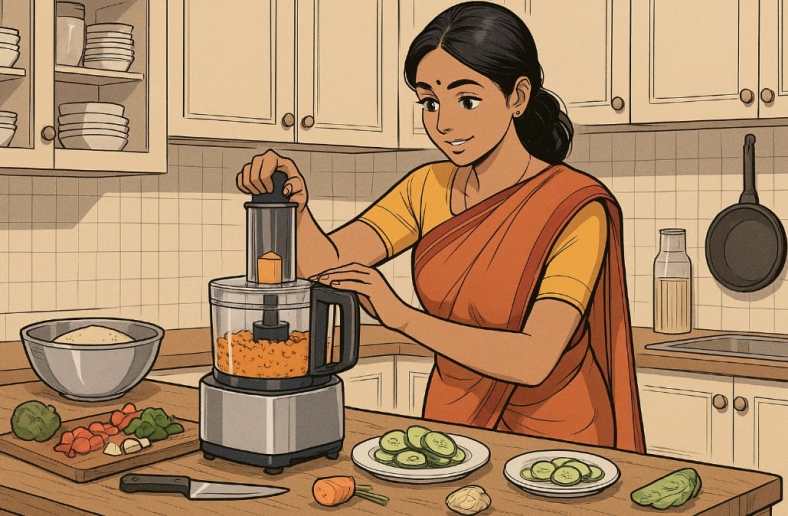
Confused about food processors? This guide helps you pick the right model and use every blade and attachment for Indian cooking needs. A food processor can save a lot of time in the kitchen but only if you choose the right one and actually use its attachments properly.
In Indian homes, where we knead dough, grate vegetables, slice for stir-fries, and prep for multiple meals daily, a food processor can be more than just a fancy appliance. But many people buy one and then leave it unused because they don’t fully understand what it can do or how it fits into a kitchen that already has a mixer grinder.
This guide will help you:
1. How to Choose the Right Food Processor for Indian Cooking
When you’re shopping for a food processor, you don’t need to get the most expensive model. You need the one that suits how you cook.
What to Look For:
- Power (Wattage):
600W to 750W is good enough for most Indian households. Avoid underpowered models below 500W they struggle with dough. - Bowl Capacity:
2L to 2.5L bowls are ideal for Indian cooking. Enough for dough, chopping sabzi, or grating for 4-5 people. - Sturdy Locking Mechanism:
You’ll be handling heavy tasks like atta kneading choose a model with strong locking lids and a stable base. - Pulse Mode:
Important for chopping onions or vegetables without turning them into paste. - Easy to Clean & Assemble:
You’ll use it more often if cleanup doesn’t feel like a chore.
Food processors don’t replace mixer grinders for spice grinding or liquid chutneys. Think of them as your prep assistant not your masala master.
2. Must-Have Attachments for Indian Use
Not all attachments are necessary. Here’s what actually matters in an Indian kitchen:
- Kneading Blade:
For atta, poori, or paratha dough. Saves elbow grease and gives consistent texture in under 1 minute. - Chopping Blade:
Useful for onion, tomatoes, cabbage, or mixed sabzi prep. Works best when used with pulse function. - Slicing Disc:
Great for slicing potatoes, carrots, cucumber, and onions perfect for stir-fry or salads. - Grating Disc:
Ideal for carrots (gajar halwa), beetroot, cheese, or dry coconut. - Whisking Disc (Optional):
Useful for beating curd, making butter, or whipping cream, but not essential for everyone. - Blender Jar / Juicer Attachment (Optional):
Skip this if you already have a separate blender or juicer.
Choose a model with fewer but sturdy, easy-to-use discs rather than one that overwhelms you with 15 plastic parts.
3. Blade Guide – What Each Food Processor Blade Does
Knowing which blade to use is what makes the difference between chaos and convenience.
Common Blade Functions:
| Blade | Best For |
|---|---|
| Chopping Blade | Onion, tomato, garlic, mixed veg |
| Kneading Blade | Atta, maida, or multi-grain dough |
| Slicing Disc | Potatoes, cucumber, carrot |
| Grating Disc | Gajar halwa, cheese, beetroot |
| Whipping Disc | Dahi, malai, or cream (optional) |
Always use the pulse function while chopping if you want larger pieces. Continuous mode may turn your onion into chutney.
4. How to Use a Food Processor for Everyday Indian Cooking
Once you know what each blade does, these are the most common ways Indian households use food processors:
4.1 Kneading Dough
- Add atta, a pinch of salt, and water in portions.
- Use the kneading blade and run the motor for 30–45 seconds.
- Scrape down once and re-run if needed.
- Soft, uniform dough without sticky hands.
4.2 Chopping Onions and Veggies
- Use the chopping blade and pulse the motor
- Don’t overload or press continuously—this turns it into a mash
- Works great for making upma, pulao, or mixed vegetable curry prep
4.3 Grating Carrots or Beetroot
- Attach the grating disc
- Push veggies through the feeder while running
- Makes gajar halwa prep 5x faster and safer (no scraped knuckles!)
4.4 Slicing Vegetables
- Perfect for salad prep or stir-fry
- Use the slicing disc and feed cucumber, potato, or onions through the chute
- Even slices save cooking time and improve texture
Conclusion – Blades, Attachments, and Everyday Uses
A food processor can do more than you think if you know what to look for and how to use it.
- Choose one based on wattage, build, and bowl size, not brand hype
- Focus on essential attachments that match your cooking style
- Understand each blade’s purpose and avoid using the wrong one
- Use it regularly for kneading, chopping, slicing, and grating it truly makes daily prep easier
Once you get used to the rhythm, you’ll wonder how you ever managed without it. The real value of a food processor lies not in how many things it claims to do but in how often you actually use it.