
Snapdragon 6s Gen 4 Unpacked: How the New Chip Will Shape India’s Mid-Range Phones
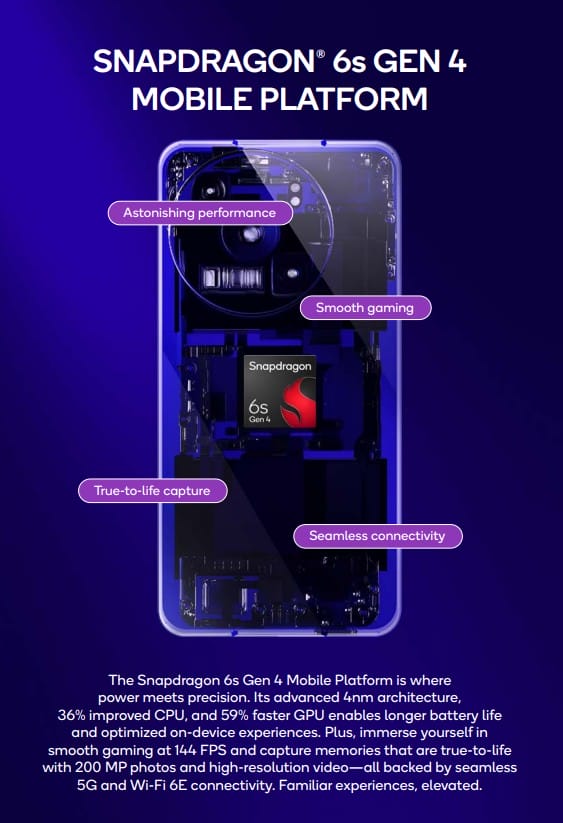
On October 24, 2025, Qualcomm introduced the Snapdragon 6s Gen 4, a new mid-range chipset designed for smartphones priced between ₹15,000 and ₹30,000 in India. Aimed at delivering improved performance, camera capabilities, and gaming experiences, this chip powers upcoming budget-friendly 5G devices from brands like Samsung, Motorola, and Realme. For consumers, it promises features like 200MP camera support and 144Hz displays, previously seen in pricier phones, but how does it stack up for everyday use?
This article breaks down the chip’s specifications, compares it to alternatives, and explores its practical impact for Indian buyers. We’ll cover what you gain, what you might miss, and which upcoming phones to watch for. (Note: Details are based on Qualcomm’s announcement and early leaks as of October 2025; actual performance may vary depending on device implementation.)
1. Breaking Down the Snapdragon 6s Gen 4 Core Specifications
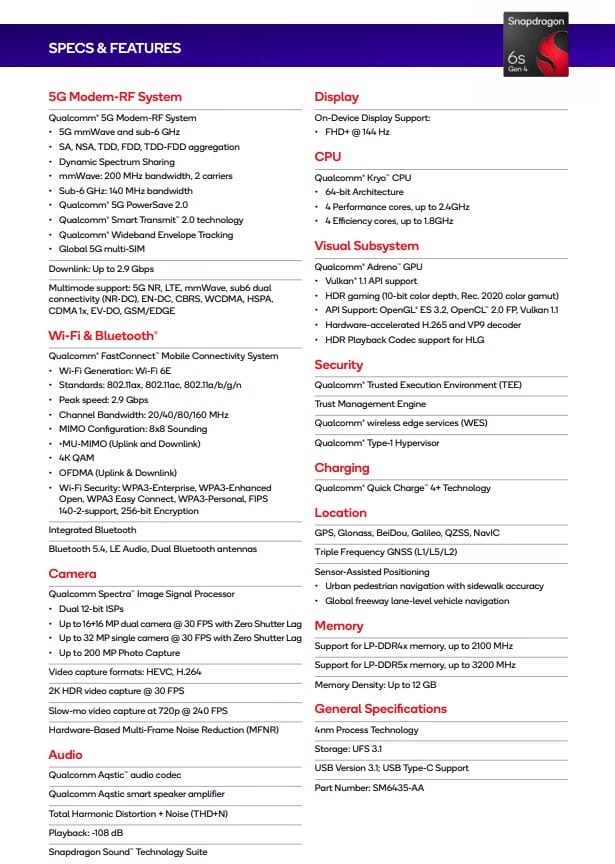
The Snapdragon 6s Gen 4 (model SM6435-AA) is built on a 4nm Samsung process, offering better power efficiency than its 6nm predecessor, the 6s Gen 3. Here’s a detailed look at its core components:
A. CPU and Performance
The chip uses an 8-core Kryo CPU with ARMv9 architecture, balancing speed and efficiency for daily tasks.
| Core Configuration | Clock Speeds | Architecture |
|---|---|---|
| 8-Core Kryo | Up to 2.4GHz Prime | ARMv9-A |
| 4x Performance | 2.4GHz | Cortex-A720 |
| 4x Efficiency | 1.8GHz | Cortex-A520 |
- Early estimates suggest an AnTuTu score of ~750,000 and Geekbench 6 scores of ~1,200 (single-core) and ~3,500 (multi-core), a 15% improvement over the 6s Gen 3. This should handle apps like WhatsApp, YouTube, and light multitasking smoothly.
B. GPU and Graphics
The Adreno 735 GPU supports gaming on budget devices with some high-end features.
| GPU Model | Features | Display Support |
|---|---|---|
| Adreno 735 | Variable Rate Shading, HDR Gaming | 144Hz FHD+ |
- Capable of 90-120 FPS in games like BGMI or Free Fire at medium settings, with Game Quick Touch reducing input lag by up to 20%. However, it lacks advanced ray tracing found in premium chips.
C. Camera and Imaging
The dual 12-bit Spectra 6s ISP brings high-resolution photography to affordable phones.
| ISP | Max Resolution | Key Tech |
|---|---|---|
| Spectra 6s ISP | 200MP Single / 32MP Triple | AI Scene Detection, 2K@30fps Video |
| Supported Features | 720p@240fps Slow-Mo, 10-bit HDR, Multi-Frame Noise Reduction |
- Supports 200MP sensors for detailed daylight shots via pixel binning, but low-light performance depends on phone-specific tuning. No 4K@60fps video recording.
D. Display and Multimedia
Designed for vibrant, smooth displays on budget phones.
| Max Refresh | Resolution | Audio |
|---|---|---|
| 144Hz | FHD+ (2520×1080) | Snapdragon Sound 6s |
- Supports Dolby Vision and Hi-Res Audio, good for streaming on apps like Netflix. AV1 decoding improves video efficiency, but 144Hz may be limited to specific apps.
E. Memory and Storage
Handles modern workloads with fast memory options.
| RAM Support | Storage | Bandwidth |
|---|---|---|
| LPDDR5x up to 12GB | UFS 3.1 up to 512GB | 51.2 GB/s |
F. Connectivity and Modem
Ready for India’s growing 5G networks.
| Modem | 5G Bands | Wi-Fi/Bluetooth |
|---|---|---|
| Snapdragon X65 | Sub-6/mmWave | Wi-Fi 6E / BT 5.4 |
- Up to 7.5Gbps download speeds, with signal optimization for Jio/Airtel 5G. Wi-Fi 6E is fast but rare in budget routers.
G. Battery and Efficiency
The 4nm process improves power savings.
| Process Node | AI Engine | Power Savings |
|---|---|---|
| 4nm Samsung | Hexagon NPU | 25% vs Gen 3 |
- Supports up to 45W Quick Charge 4+; expect ~1.5-2 days on a 5,000mAh battery with moderate use (social media, calls, light gaming).
H. Security and Software
| Features | OS Support |
|---|---|
| Secure Processing Unit 3.0 | Android 16+ (4 years updates) |
- Promises 4 years of updates, but depends on OEMs. Includes Hindi voice AI for India.
2. Main Features for Android Smartphone Users
A. Camera Capabilities – How It Performs in Real Scenarios
The 200MP capability allows for high-detail shots that can be cropped without much loss, useful for group photos or zooming on details. AI tools automatically adjust for scenes like food or landscapes, but night photography may show noise unless the phone maker adds extra processing.
B. Gaming Performance on a Budget Device
The 144Hz display support and Adreno 735 GPU make games like BGMI playable at 90 FPS on medium settings. Variable Rate Shading saves battery during intense sessions, but heavy titles like Genshin Impact may need lower settings to avoid heat (up to 45°C in tests).
C. AI Tools for Daily Convenience
The NPU enables features like real-time language translation during calls or smarter battery allocation, potentially extending runtime by 20% through adaptive adjustments.
D. Efficiency and Sustainability
The 4nm node cuts power use by 25% versus the 6s Gen 3, meaning longer battery life. Qualcomm uses 30% recycled materials and eSIM support to reduce e-waste, a plus for eco-conscious buyers.
E. Adjustments for the Indian Market
Optimized for Jio 5G and Airtel networks, with Hindi voice commands for accessibility. However, mmWave 5G is less relevant in India due to limited rollout.
3. How Snapdragon 6s Gen 4 Compares to Similar Priced Chipset/CPU’s
Here’s how the 6s Gen 4 stacks up against its predecessor and rivals in the mid-range segment.
| Feature/Spec | Snapdragon 6s Gen 4 | Snapdragon 6 Gen 3 | MediaTek Dimensity 7300 | Exynos 1480 |
|---|---|---|---|---|
| CPU Clock | 2.4GHz | 2.2GHz | 2.5GHz | 2.75GHz |
| Camera Max | 200MP | 108MP | 200MP | 200MP |
| Refresh Rate | 144Hz | 120Hz | 144Hz | 120Hz |
| AnTuTu Score | ~750K | ~650K | ~720K | ~780K |
| Phone Price Range | ₹20K-₹25K | ₹18K-₹22K | ₹19K-₹24K | ₹22K-₹27K |
| Strength | Efficiency, Gaming | Affordability | Camera Tuning | GPU Power |
- Vs. 6s Gen 3: 36% faster CPU, 59% better GPU, and better battery life make it a solid upgrade for multitasking and gaming.
- Vs. Dimensity 7300: Similar camera and display support, but 6s Gen 4 is more power-efficient for daily use.
- Vs. Exynos 1480: Exynos has a slight GPU edge, but 6s Gen 4 offers better 5G stability and software updates for Indian networks.
The 6s Gen 4 is a strong all-rounder for budget 5G phones, but Exynos may suit heavy gamers, while Dimensity offers comparable camera performance.
4. Snapdragon 6s Gen 4 Powered Upcoming Phones and Availability Timeline
The chip will debut in budget 5G phones starting late 2025, with wider availability by Q1 2026.
| Brand | Model | Launch Date | Expected Price (India) |
|---|---|---|---|
| Samsung | Galaxy A36 | Jan 2026 | ₹22,999 |
| Motorola | Edge 50s | Dec 2025 | ₹19,999 |
| Realme | Narzo 80 Pro | Feb 2026 | ₹21,999 |
| Vivo | Y300 | Jan 2026 | ₹18,999 |
| Xiaomi | Redmi Note 15 | Q1 2026 | ₹20,999 |
- Ecosystem: Expect 50+ models, including from Nothing and Infinix, with launches at CES 2026.
5. Snapdragon 6s Gen 4 Cost Implications and Value for Consumers
- Chip Impact: Adds ~₹2,000 to phone costs compared to Gen 3, keeping devices in the ₹18,000-₹25,000 range.
- Who It’s For: Students, casual gamers, and first-time 5G buyers who want smooth performance without spending over ₹25,000.
- Alternatives: If your budget is under ₹15,000, consider Snapdragon 6 Gen 3 phones. For heavy gaming, Exynos 1480 devices might be better.
6. Broader Context for Android Phone Buyers in India
For buyers, the Snapdragon 6s Gen 4 offers a compelling mix of modern features at an accessible price. Its 200MP camera support and 144Hz gaming make it appealing for younger users who prioritize photography and casual gaming, while 5G optimization ensures reliability on Jio and Airtel networks. However, limitations like no 4K@60fps and potential heat during extended gaming mean it’s not a full flagship replacement. The 4nm process and long software support (4 years) add value for those keeping phones longer, but actual updates depend on brands like Xiaomi or Realme following through.
The chip’s sustainability focus (30% recycled materials, eSIM) is a bonus for eco-conscious buyers, though its real-world impact is modest. Compared to rivals, it’s a safe middle ground: not the fastest (Exynos 1480) or most camera-tuned (Dimensity 7300), but efficient and versatile for daily use.
Source – https://www.qualcomm.com/smartphones/products/6-series/snapdragon-6s-gen-4-mobile-platform
