
Apple Vision Pro vs Galaxy XR: Can Samsung Win India’s XR Race?
The VR Headset Rivalry Heats Up – In October 2025, the virtual reality (VR) market saw two major developments: Apple refreshed its Vision Pro with the M5 chip on October 15, starting shipments on October 22, while Samsung introduced the Galaxy XR on October 21, with immediate availability in the US and Korea. Both headsets aim to advance mixed-reality experiences, blending augmented reality (AR) and virtual reality (VR) for productivity, entertainment, and more. Apple’s Vision Pro emphasizes integration within its closed ecosystem, powered by custom silicon, whereas Samsung’s Galaxy XR leverages Android’s openness and Google’s AI tools for broader accessibility. With prices at $3,499 for Vision Pro and $1,799 for Galaxy XR, this matchup highlights trade-offs between premium performance and value. Early hands-on reports suggest Galaxy XR feels lighter and more approachable, but Vision Pro delivers superior graphical capabilities.
This comparison breaks down specs, features, and implications, with a focus on markets like India, where pricing and ecosystem fit could influence adoption.
1. Technical Specs Comparison – Vision Pro M5 Vs Galaxy XR
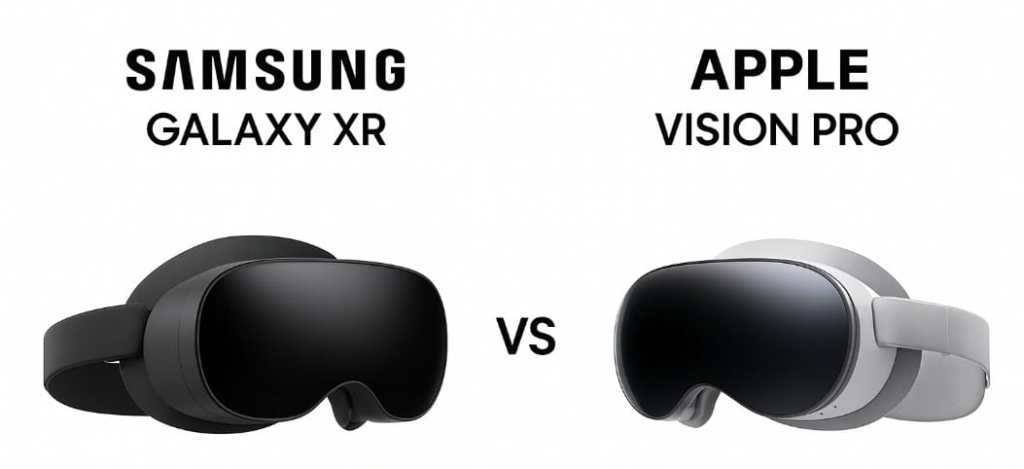
Here’s a side-by-side overview based on launch details and initial reviews, highlighting key differences in hardware and capabilities.
| Feature | Apple Vision Pro (M5) | Samsung Galaxy XR |
|---|---|---|
| Price | $3,499 (₹2.9 lakh + Tax est. in India) | $1,799 (₹1.5 lakh + Tax est. in India) |
| Processor | M5 (10-core CPU, 10-core GPU, 16-core Neural Engine) | Snapdragon XR2+ Gen 2 |
| RAM/Storage | 16GB unified memory / 256GB-1TB | 16GB RAM / 256GB |
| Display | Micro-OLED, 3,660×3,220 per eye (~23MP total), up to 120Hz | Micro-OLED, 3,552×3,840 per eye (~27MP total), up to 90Hz |
| Weight | 750-800g (with Dual Knit Band) | 545g (with forehead cushion) |
| Battery Life | Up to 3 hours video, 2.5 hours mixed use | Up to 2.5 hours video, 2 hours mixed use |
| OS/AI | visionOS 2.6 with Apple Intelligence | Android XR with Gemini AI |
| Tracking/Cameras | Eye/hand tracking, no standard controllers | Eye/hand/head tracking + 6 world-facing cameras, optional controllers ($249.99) |
| Audio | Spatial audio speakers | 2 two-way speakers + 6 microphones |
| Availability (Global/India) | Available now but not in India/ Via Apple Stores or imports (high duties) | US/Korea now, global Q1 2026 / Expected via Flipkart/Samsung in India |
2. Comparing Design and Comfort: Build Quality & Wearability
The Apple Vision Pro (M5) features a premium aluminum and glass construction with a new Dual Knit Band for better weight distribution, though it still weighs 750-800g, which can lead to discomfort during prolonged sessions based on user feedback. Its design prioritizes a sleek, high-end look, but the bulkiness has been a point of criticism in reviews.
In contrast, the Samsung Galaxy XR is lighter at 545g, incorporating soft straps and a forehead cushion for reduced pressure, along with an external battery pack that helps balance the device. It has a more practical, gadget-oriented aesthetic, which some X users describe as “less intimidating” than Apple’s offering.
Overall, Galaxy XR edges out in comfort for extended wear, particularly in warmer climates like India’s, where heat and humidity could exacerbate heavier designs. Vision Pro, however, feels more durable and premium in build quality.
3. Performance and AI: Power Under the Hood
Apple’s M5 chip in the Vision Pro brings significant upgrades, including a 10-core CPU/GPU and 16-core Neural Engine with 30% more memory bandwidth (153GB/s), enabling hardware ray tracing for enhanced graphics in apps and games. Apple Intelligence integrates deeply, offering features like improved Siri for natural queries and on-device processing for privacy.
Samsung’s Galaxy XR uses Qualcomm’s Snapdragon XR2+ Gen 2, which handles multitasking efficiently without notable overheating in early tests. Google’s Gemini AI drives multimodal features, such as real-time object recognition and 3D photo spatialization, with support for multilingual interactions.
Vision Pro leads in sheer computational power for demanding tasks like 3D rendering, but Galaxy XR’s AI integration feels more practical for everyday use, per demos. In India, Gemini’s native support for Hindi and regional languages could make Galaxy XR more inclusive for diverse users.
4. Display and Visuals: Immersion Quality
The Vision Pro’s Micro-OLED displays deliver 3,660×3,220 resolution per eye with up to 120Hz refresh rates, providing fluid motion and minimal distortion in passthrough mode, enhanced by ray tracing for realistic lighting effects.
Galaxy XR counters with a slightly higher pixel count (3,552×3,840 per eye) for sharper details, though its 90Hz maximum may introduce minor lag in fast-paced content. Its low-latency passthrough supports seamless real-world integration, like using a phone while wearing the headset.
The displays are closely matched, with Vision Pro better for gaming due to higher refresh rates, while Galaxy XR excels in color vibrancy based on side-by-side comparisons.
5. Software and Ecosystem: Apps and Integration
Vision Pro runs on visionOS 2.6, tightly integrated with Apple’s ecosystem for seamless connectivity with Macs and iPhones, though its app library remains somewhat limited to first-party and select third-party options.
Galaxy XR’s Android XR platform opens access to the Google Play Store, including native apps for YouTube, Netflix, and HBO, plus ports from Meta Quest games and tools like Adobe Pulsar for 3D editing.
Galaxy XR’s open ecosystem could lead to a faster-growing app selection, especially for sports and gaming, while Vision Pro offers more polished, integrated experiences. For India’s 800M+ Android users, Galaxy XR’s familiarity and local developer potential (e.g., custom AR apps) give it an advantage.
6. Battery, Accessories, and Practicality
Vision Pro’s battery lasts up to 3 hours for video playback, with an external tethered pack that adds to the overall weight but allows for quick swaps.
Galaxy XR provides 2-2.5 hours, also with a swappable external battery, and optional controllers ($249.99) enhance gaming though they’ve sold out quickly, indicating strong interest.
Battery life is comparable, but Galaxy XR’s lighter headset design improves practicality for mobile use.
7. Price and Availability: Value Proposition
Price Shock
- At ₹3+ lakh, the Vision Pro M5 costs more than a Maruti Alto down payment or an iPhone + MacBook combo.
- At ₹1.7-2 lakh, the Galaxy XR is cheaper but still firmly in ultra-premium territory for India.
Warranty & Service Gaps
- Neither device is supported in India officially. Import buyers risk zero repair options if something breaks.
Content & Apps
- Indian users rely heavily on Hindi, Tamil, Bengali, and regional apps for adoption. Apple has little localization yet, while Android XR’s openness gives Samsung a potential advantage but only if local devs adopt it.
Comfort in Indian Conditions
- Wearing a half-kilo headset in humid 35°C summers is no joke. Comfort and heat management are bigger issues in India than in cooler markets like the US or Korea.
Internet Readiness
- XR experiences need stable 5G or Wi-Fi 6/7. While metros have some coverage, tier-2 and tier-3 cities may struggle with bandwidth-heavy XR apps.
Galaxy XR provides stronger value for premium users, especially with potential EMI options in India.
8. Key Takeaways: Choosing Between Vision Pro M5 and Galaxy XR
Apple’s Vision Pro M5 ($3,499, ₹2.9 lakh) delivers unmatched graphical power and ecosystem polish, ideal for high-end creators but limited by its weight, closed app system, and complete lack of official availability in India (imports only, with steep duties and no local support).
Samsung’s Galaxy XR ($1,799, ₹1.5 lakh) offers lighter comfort and Android’s open platform, appealing to India’s 800M+ Android users and developers crafting local apps. However, its Q1 2026 India launch and slightly shorter battery life require patience and planning.
9. India Perspective: Market Fit and Challenges
India’s XR market is set to reach $1.3 billion by 2026, driven by education, gaming, and enterprise applications. Galaxy XR’s ₹1.5 lakh price and multilingual Gemini AI align well with India’s diverse population, supporting use cases like AR history lessons or VR training at firms like Wipro, TCS and Infosys.
Vision Pro, at an effective ₹3 lakh+ via imports, faces even steeper hurdles due to its unavailability through official channels, no Apple demos, warranty, or easy access despite Apple’s smaller market share here. This exclusion, unlike Galaxy XR’s planned Q1 2026 rollout, positions Samsung as the more realistic choice for most Indian users, though it appeals to high-end Apple loyalists willing to pay premiums. Delays for Galaxy XR vs. Vision Pro’s immediate (global) availability add uncertainty, but Android’s dominance could favor Samsung long-term.
Conclusion: Which VR Headset for You?
The battle between Apple Vision Pro M5 and Samsung Galaxy XR is exciting, but in India it remains more theoretical than practical. Both devices showcase what immersive computing could look like, but their prices, lack of availability, and ecosystem immaturity mean they’re far from mainstream here.
The Apple Vision Pro (M5) suits power users invested in Apple’s ecosystem who prioritize top-tier performance, while the Samsung Galaxy XR appeals to those seeking value, openness, and comfort in an Android-powered device.
In India, Galaxy XR’s affordability and local relevance may give it broader reach.
Sources
