
Why PC Repair in India is Slow and Costly: Parts Supply Issues and Repair Limitations
India has one of the fastest-growing PC and laptop markets, with millions of students, professionals, and gamers depending on their machines every day. But when a computer fails, the path to getting it repaired is rarely smooth. Unlike smartphones, which have more standardized repair processes, the PC repair ecosystem in India is fragmented and often unreliable.
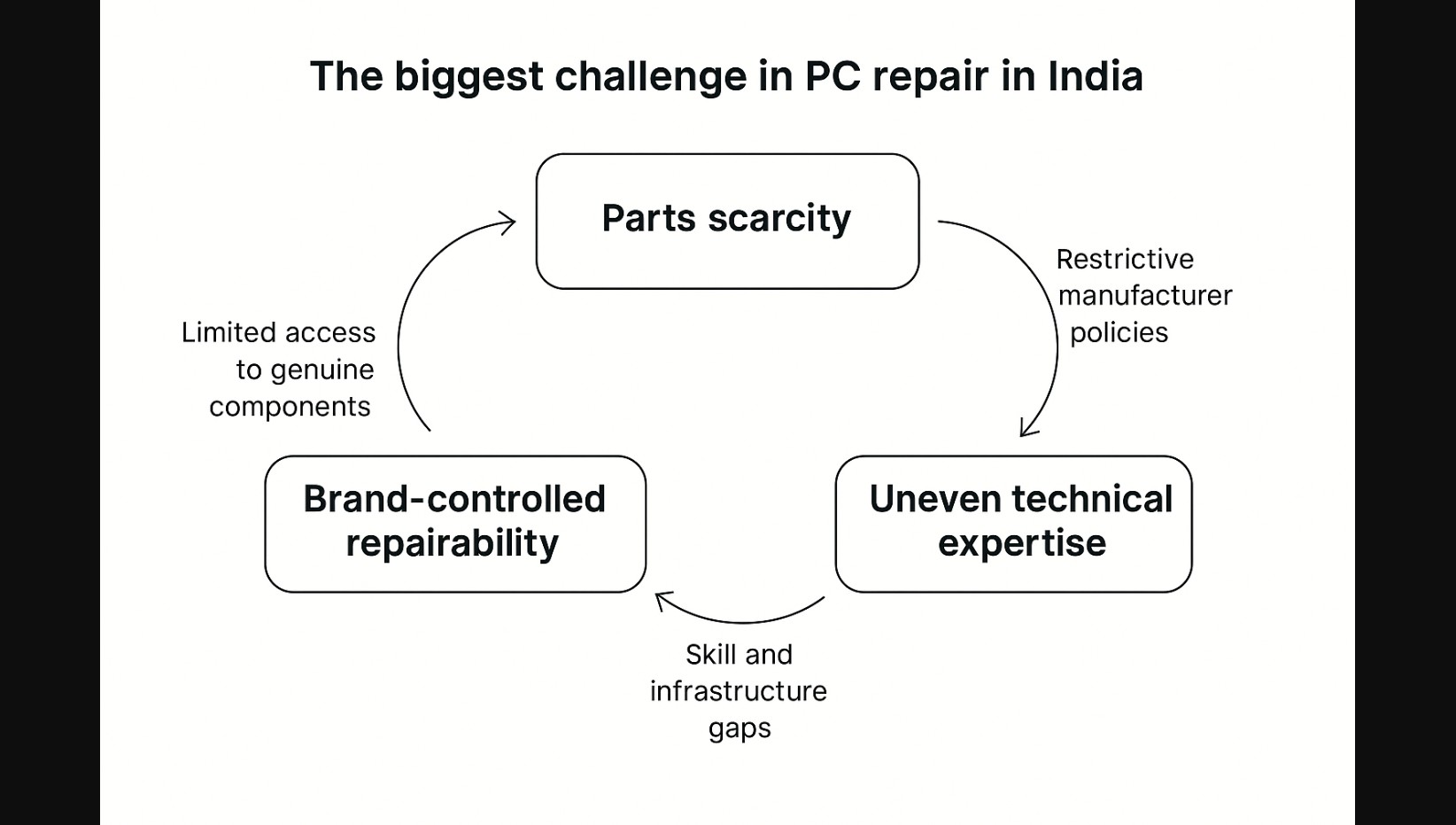
The biggest challenge in PC repair here is not just one factor, it is the interlocking cycle of limited parts availability, restrictive brand repair policies, and uneven technical expertise. Together, these three issues push repair costs higher, delay turnaround times, and leave users uncertain about whether repairing is worth it at all.
1. Why Computer Parts Access Becomes the First Roadblock
Genuine vs Third-Party PC Components
A motherboard or display for a mainstream laptop can take weeks to source in tier-2 cities. In metros like Delhi or Bengaluru, the same part may be found within a day through large electronics markets such as Nehru Place or SP Road. When genuine components are unavailable, users turn to third-party or refurbished parts, which can solve the immediate problem but often carry quality risks.
Computer Parts Pricing Gaps
The absence of a streamlined supply chain means wide price variations. A battery with a proper GST invoice may cost ₹2,500 in a metro market, while a no-bill version in a small-town shop could be ₹1,600. This inconsistency forces many customers to choose price over reliability.
2. How PC Brand Policies Restrict Repair Options
Design Choices
Many modern laptops and ultrabooks come with soldered CPU/RAM, glued batteries, and proprietary SSDs (Mac). This makes repairs unnecessarily complex and pushes customers toward entire assembly replacements.
Brand Monopoly on Service
Authorized brand service centers often swap entire boards instead of fixing components, quoting 40-60% of the device’s original price for a single repair. With India lacking a strong right-to-repair law, independent shops are left without access to schematics or official diagnostic tools.
3. PC Repair Skill and Infrastructure Gaps Across India
Uneven Capabilities
A high-end repair center in Mumbai may have microscopes, reflow stations, and technicians trained in chip-level repair, but a small-town shop might only rely on basic soldering tools and trial-and-error methods. This uneven capability widens the repair gap between urban and rural India.
PC Training Pathways
Most technicians learn through apprenticeships rather than formal electronics courses. With service manuals locked behind brand restrictions and many resources only available in English, skill development remains limited.
4. The Broader Impact on Computer Users
Longer Downtime
A student in Raipur with a dead laptop screen may wait two weeks for the part to arrive, while someone in Bengaluru gets it fixed in two days. This uneven turnaround time reflects how geography shapes repair outcomes in India.
Higher Costs
Because genuine parts are scarce and brand policies enforce expensive replacements, customers are often forced to choose between paying a premium, compromising with refurbished parts, or simply buying a new machine.
Uncertain Quality
The lack of standardization means counterfeit SSDs, low-grade batteries, and recycled motherboards regularly enter the market. For consumers, it becomes hard to judge whether their machine has been repaired with reliable components.
5. The Central Challenge: An Interlocking Cycle
At its core, the biggest challenge in Computer repair in India is this cycle:
- Parts scarcity leads to reliance on counterfeits or refurbished parts.
- Brand-controlled repairability raises costs and limits access to genuine documentation.
- Uneven technical expertise makes diagnostics slower and less reliable.
Each of these factors feeds into the others, making repair more expensive, slower, and less predictable than it should be.
6. Case Studies: How the Repair Cycle Plays Out in India
Metro City Example: Bengaluru
Rahul, a software engineer in Bengaluru, faced a motherboard failure in his two-year-old ultrabook. At the brand’s authorized service center, he was quoted ₹22,000 for a complete motherboard replacement, with a two-week turnaround. Instead, he approached an independent shop on SP Road, which sourced a refurbished motherboard within three days for ₹14,000. The repair worked, but without an official warranty, Rahul remained uncertain about how long the fix would last.
Cycle at play: Brand-controlled repairability pushed costs high, parts scarcity delayed options, and the final solution relied on uneven third-party expertise.
Small-Town Example: Bikaner
Anita, a student in Bikaner, had a broken laptop screen just before exams. The local shop promised a compatible replacement, but the part had to be couriered from Delhi’s Nehru Place, taking 7 days to arrive. The total cost was lower than official service, but she missed crucial study time.
Parts scarcity in smaller towns caused long downtime, while reliance on a single supplier reduced choice and transparency.
Gaming PC Example: Mumbai
Karan, a gamer in Mumbai, noticed his custom desktop shutting down under load. Diagnosing the issue required a power supply unit (PSU) replacement. While local Lamington Road shops offered cheaper, unbranded PSUs, a genuine one with proper wattage and certification cost nearly double. He eventually chose the branded option, but only after testing multiple low-quality alternatives.
Limited trust in part authenticity, combined with a lack of standardized testing, forced multiple attempts before resolution.
Metro vs Small-Town PC Repair in India
| Factor | Metro Cities (Delhi, Bengaluru, Mumbai) | Small Towns (Patna, Indore, Ranchi) |
|---|---|---|
| Parts Availability | Easier access via hubs like Nehru Place, SP Road, Lamington Road; same-day sourcing possible | Dependent on courier networks; delays of 7-15 days common |
| Repair Costs | Higher labor and shop rent costs; access to refurbished/genuine parts gives more flexibility | Lower labor charges; fewer part options often force compromises |
| Warranty & Invoicing | Formal GST bills available; authorized centers offer limited warranty on replaced parts | Often cash-based with no formal invoice; warranty limited or absent |
| Technical Expertise | Advanced labs with chip-level repair tools; wider technician skill pool | Basic soldering and component swaps; limited diagnostic tools |
| Turnaround Time | 2-5 days for common repairs, 1-2 weeks for rare parts | 7-15 days even for common issues due to shipping dependencies |
| Quality Assurance | Easier to cross-check shops, more transparent reviews and competition | Reliance on word-of-mouth reputation; higher risk of counterfeit parts |
7. What You Can Do as a Power PC User
While you cannot control brand policies or market gaps, there are steps you can take to reduce risks:
- Keep invoices and serial numbers safe to make warranty claims easier.
- Use surge protectors or UPS devices to prevent damage from power fluctuations.
- Back up your data before handing over your PC for repair.
- Choose repair shops that issue bills and provide written estimates, even if they cost slightly more.
- Evaluate the cost-to-benefit ratio: if a repair crosses 50% of the device’s resale value, replacement may be smarter.
Summary – The Cycle That Keeps PC Repairs Broken in India
India’s PC repair market is resourceful but constrained by systemic issues. Parts scarcity, brand restrictions, and skill gaps form a loop that keeps repair outcomes uncertain. Until supply chains improve, right-to-repair frameworks are adopted, and technical training becomes standardized, this cycle will continue to challenge both consumers and technicians.
For now, the best approach as a user is to protect your device through preventive care, make informed repair decisions, and work with trusted service providers who maintain transparency.

