
Future of Phone Batteries in India: Solid-State, Graphene, and What’s Coming
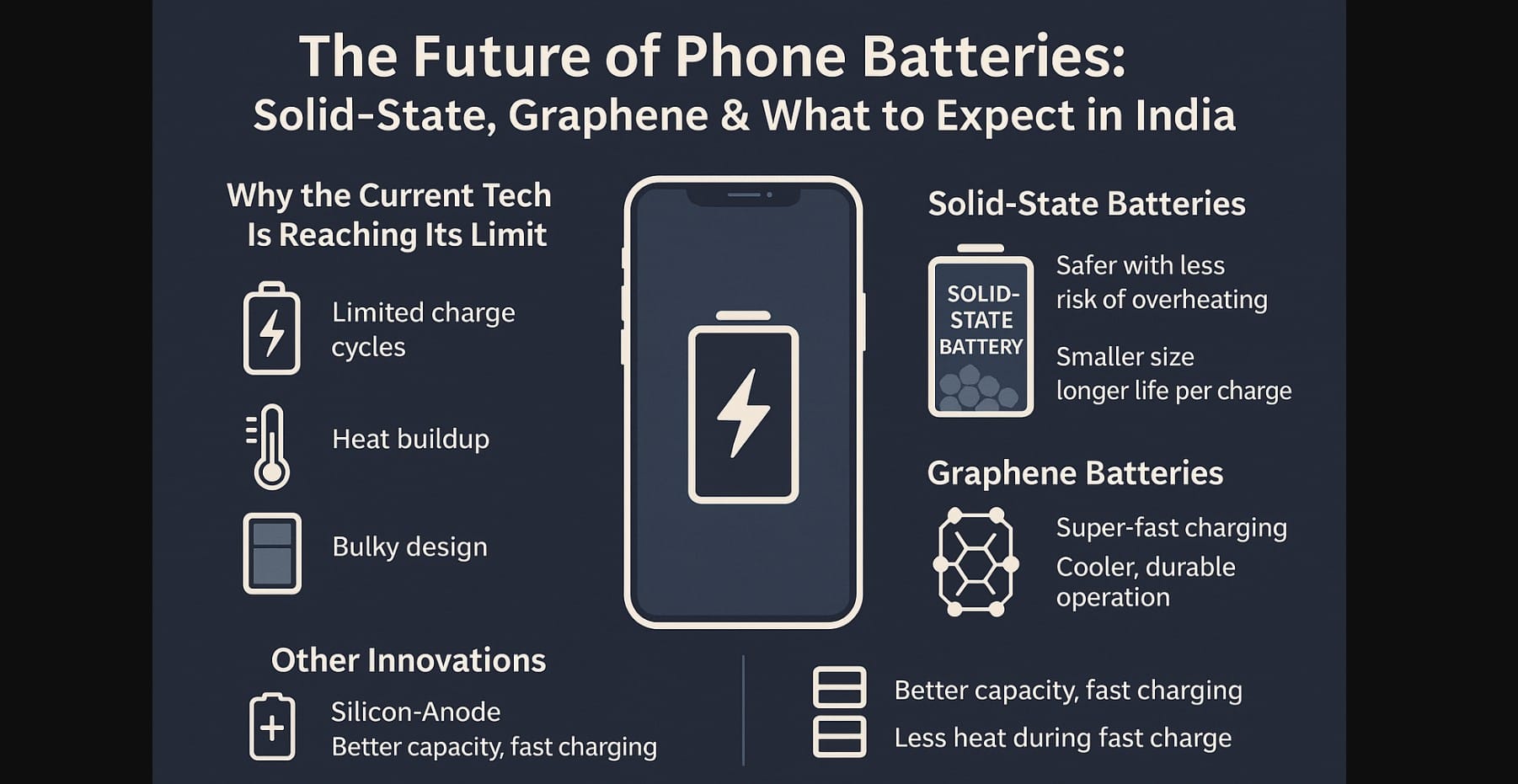
Most smartphones still run on lithium-ion batteries the same core tech used for over a decade. While they’ve gotten more compact and support faster charging, they’re starting to show their age.
Here’s why:
- They wear out with every full charge cycle
- They overheat under stress especially in Indian summer conditions
- They take up valuable internal space, limiting design and camera flexibility
With users demanding more power, slimmer phones, and faster charging, manufacturers are now investing in next-generation battery tech and it’s heading to India sooner than you think.
1. Solid-State Batteries: Safer, Cooler, More Compact
Solid-state batteries replace the liquid or gel electrolyte inside traditional lithium-ion batteries with a solid material. This small change brings big advantages:
- Higher energy density: More power in less space
- Lower risk of overheating, leaking, or swelling
- Better long-term stability and charge cycles
Many global giants Apple, Samsung, and Toyota among them are testing solid-state batteries. The challenge? Mass production is expensive and difficult.
In India, you may first see solid-state batteries in flagship devices like foldables or ultra-premium phones by 2026-2027, once global supply chains stabilize. It’s not likely for budget or mid-range phones until after that.
2. Graphene Batteries: Fast Charging With Less Heat
Graphene is often called a “miracle material” just one atom thick but incredibly conductive and durable. In theory, it allows for:
- Faster charging sometimes 10x faster
- Less heat build-up, even at high wattages
- Longer battery lifespan, with more cycles
Some brands (like Realme and Infinix) have already introduced “graphene-enhanced” batteries in India, but these are not full graphene batteries just hybrid designs to aid cooling.
True graphene batteries are still in development. If breakthroughs happen, Indian users may start seeing them in gaming phones or premium flagships by late 2025 or 2026.
3. Other Battery Technologies That Might Arrive First
While solid-state and full graphene batteries are still evolving, some new battery improvements are already being rolled out in India:
Silicon-Anode Batteries
- Replace graphite with silicon for higher capacity and longer life
- Already used in Tesla cars, now being tested in smartphones
- Could reach mid-range Android phones in India by 2025-26
Dual-Cell Batteries
- Already used in Realme, Oppo, Xiaomi devices
- Splits power into two cells for faster charging with less heat
Stacked Battery Designs
- Stacks battery cells vertically like SSDs
- Saves internal space, improves heat dissipation
- May help foldables and slim phones improve power without size increase
4. What This Means for Smartphone Buyers
These technologies won’t show up overnight but you’ll see gradual improvements over the next 2-3 years:
- More phones with dual-cell, faster-charging, and heat-optimized designs
- Flagships with silicon-anode or graphene-enhanced batteries
- First wave of solid-state batteries in ultra-premium models
For now, brands are focused on improving existing lithium-ion tech with:
- Smart charging management
- AI-based power optimization
- Cooler designs and better internal layouts
5. Upcoming New Battery Tech vs Today
| Battery Type | Key Benefit | When It Might Reach India |
|---|---|---|
| Solid-State | Cooler, denser, safer | Premium flagships by 2026-27 |
| Graphene | Ultra-fast charging, longer life | Gaming/premium phones in 2025-26 |
| Silicon-Anode | More power, less wear | Mid-range phones by 2025 |
| Dual-Cell | Faster charging, less heat | Already used in many Indian models |
If you’re buying a phone, don’t wait for solid-state or graphene unless you’re looking at top-end devices. But do look for signs that battery tech is getting smarter:
- Phones with AI charging optimization
- Battery health tracking and cooler charging
- Fast charging with safety certifications (BIS, TÜV)
The real change in India will be how quickly these technologies become affordable, and this is likely to happen faster than it did with 5G.

