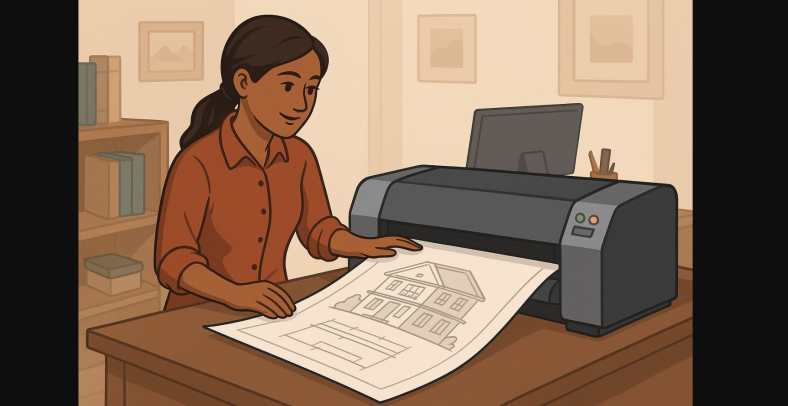
In most homes and offices, printing stops at A4. But if you’re in architecture, design, civil engineering, or the creative arts in India, you know that standard-size sheets don’t always cut it.
Whether you’re printing architectural plans, A1-sized college panels, textile patterns, or wall art, large-format printers open up a world beyond the ordinary in both scale and visual impact.
This post isn’t just for those planning to buy. It’s for anyone in India working with oversized prints, helping you understand what these printers can do, who actually needs one, and whether it makes sense to invest or outsource.
1. What Exactly Is a Large Format Printer?
At its core, a large format printer is just what it sounds like a printer that can handle paper wider than standard A4 or A3 sizes. These machines print up to A2, A1, A0, or even wider with roll-fed paper systems.
But they’re not just “big inkjets.” They’re designed for:
- Detailed technical drawings
- Oversized posters and banners
- High-resolution art prints
- Professional presentation boards
Think of it as a specialized tool something between a studio-grade photo printer and an engineering plotter depending on your work.
A signage shop in Surat might use one daily for roll-fed flex printing, while an architecture student in Delhi might need it just twice a semester for thesis panels.
2. Who Actually Needs Large Format Printing in India?
These printers are highly purpose-driven. If your job depends on clarity at scale or professional presentation, chances are you’ve already dealt with one.
Here are some common Indian use cases:
| Professional | What They Print |
|---|---|
| Architects / Civil Engineers | Blueprints, site plans, construction layouts |
| Design or Architecture Students | Presentation panels, final design boards |
| Photographers / Artists | Panoramic prints, wall art, gallery displays |
| Event Planners / Agencies | Banners, backdrops, flex printing |
| Tuition Centers / Schools | Posters, visual aids, classroom charts |
| Fashion / Textile Designers | Pattern layouts, print previews on fabric |
| Print Shops / Studios | All of the above often outsourced by others |
3. Key Large Format Printer Features
If you’re buying or even working with a large format printer, here are the things you need to care about not just specs on paper, but what they mean for real work.
Supported Sizes
Most printers cover A2 (420mm), A1 (594mm), or A0 (841mm). Some allow custom roll-fed widths, making them suitable for banners or panoramic jobs. Check what sheet sizes your work demands before picking a model.
Ink System
- Pigment-based inks last longer, resist water, and offer sharper text ideal for blueprints and display work.
- Dye-based inks are vivid but less durable better suited for photo printing.
- Some printers use 6, 8, or even 12 colors for richer gradation great for artists or photographers.
Resolution & Detail
Look for at least 1200 x 1200 dpi if your work includes intricate lines or textures. That level of clarity matters in both design and documentation.
Media Handling
Don’t assume all printers support your preferred material. Confirm compatibility with:
- Coated/uncoated bond paper
- Glossy/matte photo sheets
- Canvas or fabric sheets (for creatives)
- Vinyl or synthetic film (for banners/posters)
Software & Connectivity
If your workflow involves tools like AutoCAD, Revit, Illustrator, or Photoshop, make sure the printer has compatible drivers and good preview software.
Also check for:
- Wi-Fi or Ethernet printing
- USB/SD support for direct file printing
- Easy access to ICC profiles for color-sensitive work
4. Buy Large Format Printer or Outsource? What Makes Sense in India
A common dilemma especially for freelancers or small offices is whether to buy or keep using print studios.
Here’s how to decide:
| Situation | Recommendation |
|---|---|
| Printing 2-5 large sheets/week | Buying makes sense over time |
| Handling confidential or sensitive files | In-house printing avoids leaks |
| High-end client deliverables or art sales | Quality control is easier in-house |
| Printing once a semester or during exams | Outsource it no need to buy |
| You need to print on a wide variety of materials | Specialized printer preferred |
| Budget under ₹1 Lakh | Stick to A2 or entry-level A1 models |
A small branding agency in Chennai bought an A1 ink tank printer after calculating that outsourced printing cost them ₹30,000 every 3 months. Their new setup paid for itself in less than a year.
5. Large Format Printer Cost Breakdown (Indian Market)
Knowing what you’ll spend is just as important as knowing what to buy. Here’s a realistic snapshot:
| Type | Estimated Cost |
|---|---|
| Entry-level A2 printer | ₹60,000 – ₹1.2 Lakh |
| Mid-range A1/A0 model | ₹1.5 – ₹3 Lakh |
| 8-12 color pro art printer | ₹3 – ₹6 Lakh |
| Per A1 print (in-house) | ₹30 – ₹80 |
| Outsourced A1 print | ₹70 – ₹150 per sheet |
| Pigment ink refill packs | ₹5,000 – ₹15,000 depending on brand and capacity |
6. What Large Format Printer Buyers Often Overlook
These common missteps can cost you:
- Assuming roll-fed means auto-cut some printers don’t cut paper after printing
- Buying non-pigment models for engineering prints may fade over time
- Ignoring paper size clearance you’ll need space both behind and in front
- Forgetting to check print software support especially for AutoCAD users
- Paying for features like textile printing when you only use plain sheets
A signage business in Jaipur upgraded to a roll-fed system without realizing it didn’t auto-cut. The extra work delayed every delivery. Lesson learned.
7. Big Prints, Big Value
Large format printers aren’t everyday machines, but they’re essential for professionals who create big ideas and need to see them at full scale. Whether you’re presenting plans to a client, showcasing your art in a gallery, or printing lecture visuals for a classroom the right printer saves time, ensures clarity, and gives your work the finish it deserves.
If you print regularly and care about quality, buying makes sense. If not, your local studio might still be your best bet. Either way, knowing what matters paper size, ink type, compatibility, and cost helps you print smarter.
