
Why All-in-One Desktop Computer Failed in India and What Buyers Chose Instead
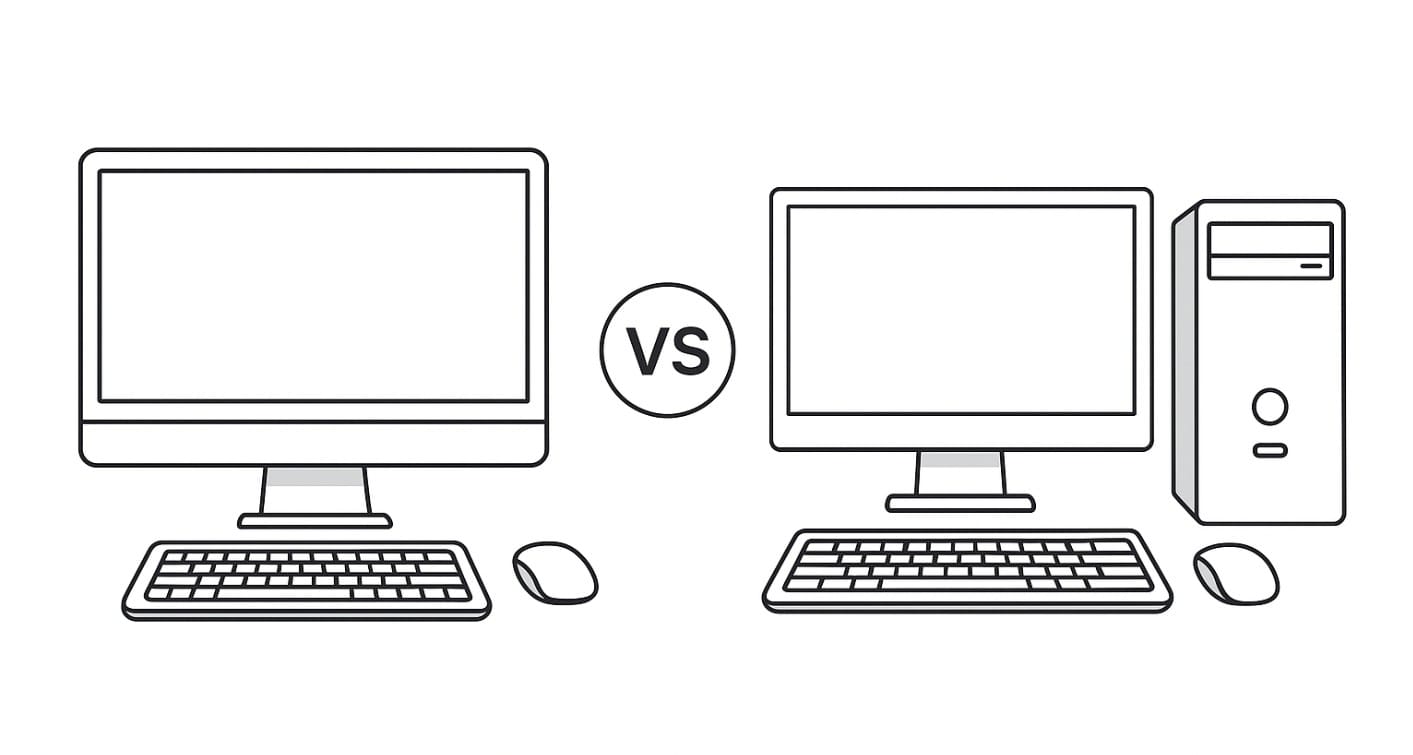
When All-in-One (AIO) desktops entered the Indian market, brands pitched them as the future of home and office computing. They were marketed as sleek, space-saving alternatives to bulky computer towers/cases, a single unit with monitor and PC combined. On paper, the idea looked perfect for a country moving toward compact homes and modern offices.
Yet, two decades later, AIO computers remain a tiny niche. Walk into any household, and you’ll likely find a laptop or a conventional desktop, almost never an All-in-One (AIO). The adoption rate has been so low that most retailers stock only a handful of models, mostly as display pieces. The reasons behind this failure tell you a lot about how buyers think about technology.
1. Why India Rejected All-in-One (AIO) Computers
Price Without Purpose
AIO desktops were consistently priced higher than comparable desktops and, in many cases, close to mid-range laptops. For an Indian buyer with ₹50,000 to spend, a laptop made far more sense: it offered the same performance, came with a built-in UPS (battery), and could travel between home, office, or hostel. AIOs, tied to a desk and offering no portability, simply didn’t justify their premium.
The Problem of Repairs and Upgrades
In India, desktops are rarely replaced every two years. A typical buyer wants 5-7 years of use, with the option to upgrade RAM, storage, or GPU over time. AIOs broke this cycle. Their compact, proprietary parts made even basic repairs expensive and inconvenient.
At places like Nehru Place (Delhi), Lamington Road (Mumbai), or Ritchie Street (Chennai), you can fix or upgrade a desktop cheaply with standard components. But if an AIO motherboard or screen failed, the cost of repair often ran into tens of thousands, sometimes more than the device’s residual value. Local repair shops avoided them altogether, leaving buyers dependent on brand service centers.
Portability and Power Cuts
Unlike laptops, AIOs don’t have batteries. In India, where power cuts are still common in smaller cities and towns, a desktop that shuts down abruptly has little appeal. A laptop at the same price solves this problem.
Service Reach and Spare Parts
Beyond metros, brand service centers for AIOs were thinly spread. Waiting weeks for proprietary spares became a dealbreaker. Compare that with a desktop PC: almost every town has at least one shop that can swap in a standard PSU, GPU, or RAM module the same day.
2. The Cultural Shift Toward Laptops
All-in-One (AIO) computers entered India at the wrong time. By the mid-2010s, households that once bought desktops were buying laptops as family PCs. A laptop was not only portable but also usable during outages, fit better in small apartments, and supported a growing culture of personal rather than shared computing.
This shift meant that the core target market for AIOs, families wanting a shared, stylish PC, had already moved on to laptops.
3. Offices and Institutions Looked Elsewhere
Manufacturers hoped that businesses would adopt All-in-One (AIO) PC for their compactness and tidier desks. But Indian enterprises, call centers, and schools preferred:
- Traditional desktops, which were cheaper to deploy in bulk and easier to maintain.
- Thin clients or mini-PCs, which offered similar compactness at lower costs.
- Laptops with docking stations, which doubled as portable devices.
Even in government tenders, AIOs were rarely chosen because maintenance contracts became costlier than for desktops.
4. Limited Exceptions in the Indian Market
While AIO computers largely failed to capture mainstream buyers, a few models carved out small but noticeable niches:
- Apple iMacs continued to attract design studios, media houses, and creative professionals. For this segment, the combination of a calibrated display, macOS ecosystem, and brand appeal outweighed concerns about repairability or price. However, these purchases remained confined to premium users in metro cities.
- HP and Lenovo AIOs found some demand in schools, call centers, and reception desks, where the compact form factor helped save space and reduced visible cable clutter. Yet, these deployments were often temporary, as organizations realized that mini-PCs or thin clients offered the same desk footprint with lower costs and easier maintenance.
These pockets of adoption never grew into larger trends. Instead, they highlighted the narrow circumstances under which AIOs made sense in India: when aesthetics or space-saving mattered more than cost and serviceability.
5. Comparing PC Options in the Indian Market
| Feature | AIO Desktop | Laptop | Traditional Desktop | Mini-PC + Monitor |
|---|---|---|---|---|
| Price | High for given specs | Medium-High | Flexible, all budgets | Medium |
| Portability | None | High | None | Medium (easy to carry) |
| Repairability | Low (proprietary parts) | Moderate | High | Moderate |
| Battery Backup | No | Yes | No | No |
| Adoption in India | Very low | Very high | Steady | Growing |
This table shows why buyers consistently ignored AIOs, they lacked the key advantages of both desktops and laptops, while carrying the disadvantages of both.
6. The Current PC Trends in India
Today, AIO desktops remain a small, luxury or institutional purchase. Apple iMacs continue to serve niche creative markets, but beyond that, AIOs are invisible in Indian sales charts. Meanwhile:
- Laptops dominate as the default family or student PC.
- Desktops remain strong among gamers and workstation users.
- Mini-PCs are quietly gaining ground as a more logical compact alternative to AIOs.
7. Future Outlook for Compact PC in India
All-in-One desktops are unlikely to stage a comeback in India. Their positioning as “stylish family PCs” has been permanently overtaken by laptops, which solve portability and power-backup issues better. Even in offices, the compact-desk niche is increasingly being filled by mini-PCs and thin clients, which are cheaper, easier to maintain, and more service-friendly.
What we may see instead is:
- Greater adoption of mini-PC
- Growth of SFF desktops: Gamers and professionals in metros are more willing to pay extra for compact cases with SFX PSUs, as seen in the rising demand for Cooler Master and Lian Li cases.
- Decline of budget AIOs: Even institutional buyers (schools, small offices) are shifting to modular PC + monitor combos, since they’re easier to replace and upgrade.
- Sustained niche for iMacs: Apple’s iMac will likely remain in creative fields, but more as part of the Apple ecosystem rather than as an “AIO desktop.”
In short, the future of compact computing in India doesn’t belong to AIOs, it belongs to laptops, mini-PCs and SFF desktops, which deliver the same space-saving promise with better value and longevity.
8. Summary – Compact Clean PC Design, Wrong Market
AIO desktops didn’t fail because they lacked performance. They failed because they didn’t solve Indian buyers’ problems. In a market where people look for cost, portability, battery backup, and long-term repairability, AIOs offered none of these advantages.
Their story in India is a reminder that design alone doesn’t sell, relevance does. AIOs promised style, but in India, the practical value of laptops and desktops made them the smarter choice every single time.

