
From Imports to Innovation: The Strategic Significance of DHRUV64 Processor for India
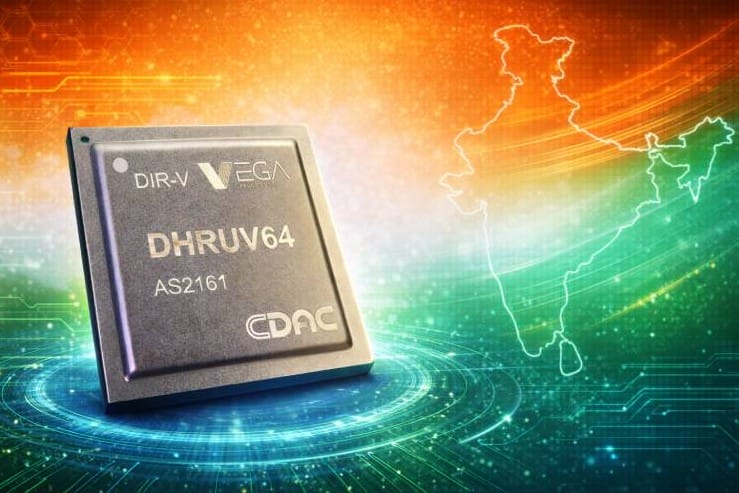
On December 15, 2025, India announced a key milestone in its semiconductor journey with the launch of DHRUV64, the nation’s first fully indigenous 1.0 GHz, 64-bit dual-core microprocessor. Developed by the Centre for Development of Advanced Computing (C-DAC) under the Microprocessor Development Program (MDP), DHRUV64 strengthens India’s domestic processor pipeline and marks a major step toward self-reliance in advanced chip technology.
While its raw clock speed and core count may not match the latest consumer chips, this launch is strategic rather than competitive on benchmark race terms. Its value lies in building domestic capability, supporting long-term digital autonomy, and laying the groundwork for a future where India is not just a chip importer but also a designer and contributor in the global semiconductor ecosystem.
India’s Chip Position Before DHRUV64 Processor
For decades, India has been a major consumer of microprocessors without equivalent domestic design or manufacturing capacity. According to the government, India accounts for approximately 20 % of all microprocessors consumed globally, yet until now almost all have been imported.
Previous indigenous efforts such as SHAKTI (IIT Madras) and AJIT (IIT Bombay) helped build design experience, but DHRUV64 is the first processor that marries modern features, 64-bit architecture and broader applicability under a common national program backed by government initiatives. (Press Information Bureau)
What is the DHRUV64 Processor? Basic Features Explained
The DHRUV64 is India’s first completely Indian-designed 64-bit dual-core microprocessor running at 1.0 GHz. It is built on the RISC-V architecture, which is free and open for anyone to use and change.
Here are its main features in simple terms:
- Cores and Speed: Two cores, clocked at 1 GHz. It uses advanced techniques like out-of-order execution (which means it can rearrange tasks for better speed) and a 13-16 stage pipeline.
- Memory Support: It has separate paths for instructions and data (Harvard architecture), configurable caches (small fast memory like 32 KB for instructions and data, up to 512 KB shared), and a full Memory Management Unit (MMU) to run operating systems like Linux.
- Extra Capabilities: Supports floating-point math (for calculations with decimals), branch prediction (to guess next steps and save time), and up to 127 interrupts (for handling urgent tasks).
- Connections: Uses standard interfaces like AXI4 to connect with other hardware easily.
- Integrated into the wider Digital India RISC-V (DIR-V) program, which promotes chip design, prototyping and testing using the open-source RISC-V instruction set architecture (ISA)
- Software: It can run full Linux, and work is ongoing for real-time systems like Zephyr and FreeRTOS.
- Uses: Perfect for 5G networks, cars, consumer gadgets, factory machines, Internet of Things (IoT) devices, and more.
Unlike most commercial CPUs whose performance is measured in raw GHz and multi-cores for mobile or server heavy workloads, DHRUV64’s design emphasizes system-level integration and practical adoption across domains where long life cycles and reliability matter.
Why the Specs Seem “Old” But Are Strategic
The DHRUV64’s 1 GHz dual-core seems like something from 20 years ago. Early Pentium chips from the 2000s were around that speed.
Today’s top processors are very powerful. For example:
| Feature | DHRUV64 (India) | Latest Intel/AMD PC Chips | Latest Phone Chips (e.g., Snapdragon) |
|---|---|---|---|
| Cores | 2 | 16-24 | 8-12 |
| Speed | 1 GHz | 5-6 GHz | 3-4 GHz |
| Architecture | RISC-V (Open, Free) | x86 (Owned by companies) | ARM (Needs License) |
| Main Use | Embedded systems, critical infrastructure | Gaming, AI, heavy work | Phones, tablets |
| Cost to Design | Low (No license fees) | High | High |
But remember the goal: This chip is for “embedded” uses – things like controlling machines in factories, 5G towers, car systems, or IoT sensors. In these areas:
- You don’t need super speed; you need low power use, reliability, and security.
- High-speed chips can be overkill and waste energy.
- Foreign chips might have hidden risks (like backdoors for spying).
Plus, RISC-V is open. Companies like ARM or Intel charge big fees for their designs. India chose RISC-V to save money and customize freely.
Design Intent Is Not Purely Performance
DHRUV64 is built for platform capability, ecosystem anchoring and autonomy, not chart-topping consumer performance. Its design:
- Supports 64-bit processing for modern operating systems
- Offers architectural features suitable for embedded and infrastructure tasks
- Enables integration with other system components
- Boots and runs software stacks like Linux, a critical step toward usable platforms
Open Architecture Lowers Barriers
By using the RISC-V ISA, the design avoids costly proprietary licensing fees. This makes it more accessible for Indian startups, academia and industry to innovate without heavy dependency on foreign IP.
Maturity Enables Reliability
Modest clock speeds and core counts often translate into:
- Lower power consumption
- Simpler validation
- Wider compatibility with diverse hardware environments
For sectors like industrial automation, infrastructure controls, automotive systems and strategic electronics, stability and long support windows are more critical than peak performance.
What DHRUV64 CPU Means for India’s Semiconductor Ecosystem
Strengthening Sovereignty and Reducing Import Dependence
Instead of importing 100 % of its microprocessors, India now has a homegrown processor platform that can be deployed in sensitive, strategic and commercial contexts. This reduces reliance on global supply chains that can be vulnerable to disruptions or geopolitical tensions. (DD News)
Building an Ecosystem Around Design
With an indigenous design like DHRUV64:
- Domestic engineers gain experience in real-world processor development
- Chip designers can build derivatives or custom variants
- India can begin to standardize on domestic hardware for government, defence and critical infrastructure
The open-source nature of RISC-V accelerates collaboration between researchers, startups and established firms.
India’s Long Journey to Make Its Own Chips
India has been trying to build its own processors for years. Here’s a simple timeline:
- 2018: SHAKTI project by IIT Madras – First RISC-V chips for defense and space.
- 2018: AJIT by IIT Bombay – For industry and robots.
- Recent years: THEJAS32 and THEJAS64 by C-DAC – Earlier versions made in Malaysia and India.
- 2025: VIKRAM for space missions.
- December 2025: DHRUV64 launched – The most advanced yet, fully 64-bit dual-core at 1 GHz.
These efforts are part of programs like Digital India RISC-V (DIR-V) and Microprocessor Development Program.
India uses about 20% of all chips made in the world, but makes almost none. We import most from Taiwan, USA, or China. This is risky – if supply stops (like during COVID or trade wars), important systems suffer.
Defense, power plants, and telecom need secure chips. Foreign ones might have vulnerabilities.
DHRUV64 changes this. It’s fully Indian-designed, so we control it completely.
Why This Chip is Very Important for India’s Independence
Even with lower specs, DHRUV64 is a game-changer. Here’s why:
- Less Dependence on Imports: India spends billions importing chips. This homegrown one reduces that, especially for critical areas like 5G, cars, and defense. No more worrying about sanctions or shortages.
- Better Security: We can check the entire design for safety. No hidden risks from foreign makers. Perfect for government, military, and infrastructure.
- Builds Skills and Jobs: India has 20% of the world’s chip designers. This gives them a platform to innovate. Startups and students can build products cheaply without foreign chips.
- Open and Free Design: RISC-V means no license costs. Easy to modify for special needs.
- Supports Key Sectors:
- 5G networks: Reliable Indian chips for base stations.
- Cars: Safe controllers for electric vehicles.
- IoT: Billions of connected devices.
- Factories: Automation without foreign tech.
In sensitive places like nuclear plants or smart grids, trust matters more than speed.
This aligns with “Aatmanirbhar Bharat” – self-reliant India.
The Road to Becoming a Chip Exporter – Opportunities and Global Role
Right now, focus is on using DHRUV64 inside India. But it opens doors for the future:
- Next Chips Coming: Dhanush and Dhanush+ – Faster, more cores.
- New Factories: India is building chip plants (28nm by 2026). Soon, we can make these fully in India.
- Global Market: RISC-V is growing worldwide. Countries want alternatives to ARM/Intel. India can sell customized chips to Africa, Asia, etc., where cost and security are key.
- Government Help: India Semiconductor Mission invests billions. Partnerships with companies will help scale up.
One day, India could export chips, create jobs, and earn money – like Taiwan or South Korea do now.
Challenges Ahead and Bright Future
For DHRUV64 to fully transform India’s semiconductor landscape:
- A robust hardware and software ecosystem needs to grow around it
- Development tools, compilers, libraries and vendor support must be strengthened
- Scaled manufacturing relationships, possibly with international foundries, are needed
- Larger, higher-performance chips must follow to capture broader commercial markets
These are long-term objectives, but the launch of DHRUV64 marks the first clear step on that path.
and There are hurdles:
- Fabrication (making the chip) still partly abroad.
- Need more investment and talent.
- Catching up to latest tech nodes (like 2nm).
But progress is fast. From basic prototypes to DHRUV64 in years shows strong growth. Experts say this is a “strategic win.” Speed will come later; control and independence come now.
DHRUV64: More Than Just Numbers
The DHRUV64 may not win speed tests against global giants, but its value is in what it stands for: India’s growing strength in technology. It protects our security, saves money, builds skills, and sets the stage for bigger things.
This is a proud moment. With continued support, India can move from importer to leader in chips. The journey has just started, and it’s exciting!
